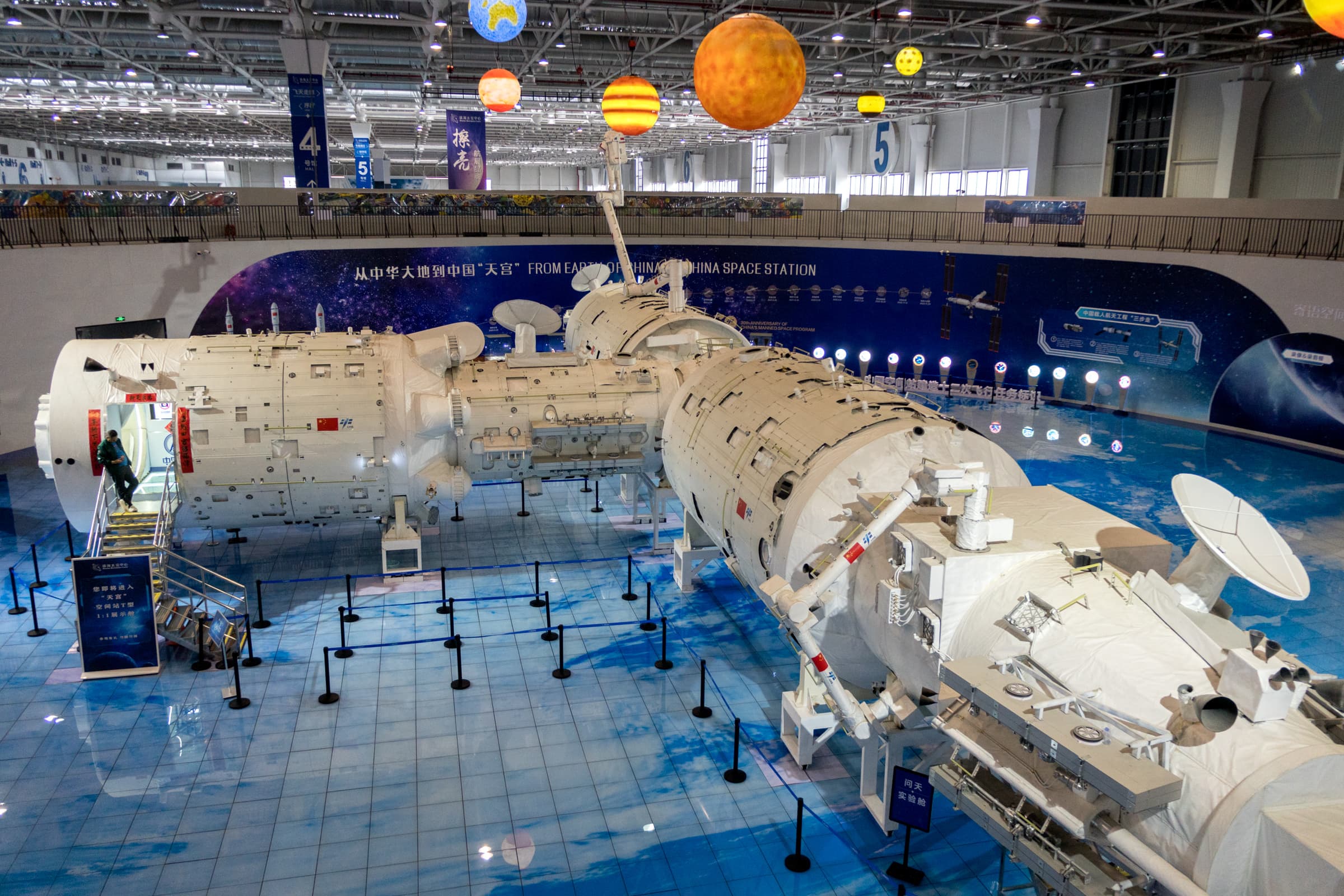
Iqbal’s couplet reaches Tiangong
Muhammad Zeeshan Ali, the Pakistani astronaut and the country’s first person in space, recited Allama Iqbal while floating inside China’s Tiangong space station on Wednesday. In a blue flight suit marked with Pakistan’s green-and-white flag, and with five Chinese crewmates around him, he delivered a familiar Urdu couplet before rendering its meaning in Mandarin.
“Sitaron se aage jahan aur bhi hain / abhi ishq ke imtihan aur bhi hain,” he said, pausing between the lines and repeating the opening phrase as he steadied himself in microgravity. He then told his crewmates that countless worlds lie beyond the stars, and that countless trials still lie ahead. After a thank-you and a smile, the crew clapped, cheered, and shared midair hugs.
A verse that has crossed borders before
Iqbal’s poetry has reached orbit more than once. In April 1984, Indian Air Force squadron leader Rakesh Sharma flew on the Soviet Soyuz T-11 mission and spent nearly eight days on Salyut 7. When then-Indian Prime Minister Indira Gandhi asked how India looked from above, he answered without hesitation that it was better than the whole world—an echo of Iqbal’s 1904 poem Tarana-e-Hindi and its line “Sare jahan se achha, Hindustan hamara.”
In November 1997, during Kalpana Chawla’s first flight on the US space shuttle Columbia, then-Indian Prime Minister Inder Kumar Gujral—born in Jhelum, in what is now Pakistan, and fluent in Urdu—quoted the opening of the same couplet Muhammad Zeeshan Ali later read on Tiangong. Gujral asked how it felt to have seen worlds beyond the stars; Chawla called the view a special, storybook-like dome of dark sky and stars.
Who Allama Iqbal was
Allama Muhammad Iqbal, born on 9 November 1877 in Sialkot in then-British India, was a poet, philosopher and political thinker whose Urdu and Persian verse still shapes South Asian cultural memory. He studied in Lahore, England and Germany, qualified in law, and earned a doctorate in philosophy. In a 1930 address in Allahabad he proposed bringing Punjab, the North-West Frontier Province, Sindh and Balochistan into one self-governing state—an idea later linked to Pakistan’s creation, though he did not use that name. He died in Lahore on 21 April 1938, nine years before Partition.
For many Pakistanis, hearing the Pakistani astronaut speak Iqbal’s words above Earth feels like a national first meeting an older cultural thread. For listeners across the subcontinent, it also recalls how the same poet’s lines have surfaced in Indian space conversations decades apart.
Timeline: what has happened so far
- 9 November 1877: Muhammad Iqbal is born in Sialkot; he later becomes known across South Asia as Allama.
- 3 April 1984: Rakesh Sharma, India’s first astronaut, invokes Iqbal’s Tarana-e-Hindi while speaking from Salyut 7 with Indira Gandhi.
- 19 November 1997: Kalpana Chawla launches on Columbia; Inder Kumar Gujral quotes Iqbal’s “worlds beyond stars” couplet to her from Earth.
- Wednesday (Tiangong mission): Muhammad Zeeshan Ali recites that couplet in Urdu on China’s space station and translates it into Mandarin for his crewmates.
Aasan alfaaz mein
Pakistan ke pehle astronaut Muhammad Zeeshan Ali ne China ke Tiangong station par Allama Iqbal ka sher parha. Unhon ne Urdu ke baad Mandarin mein matlab bataya, aur Chinese crew ne taliyan aur jhappiyan di. Yehi soch pehle bhi Indian astronauts ke saath space talk mein aa chuki hai. Seedhi baat ye hai ke Iqbal ke alfaaz ab Pakistan aur India dono ki space kahani mein milte hain.