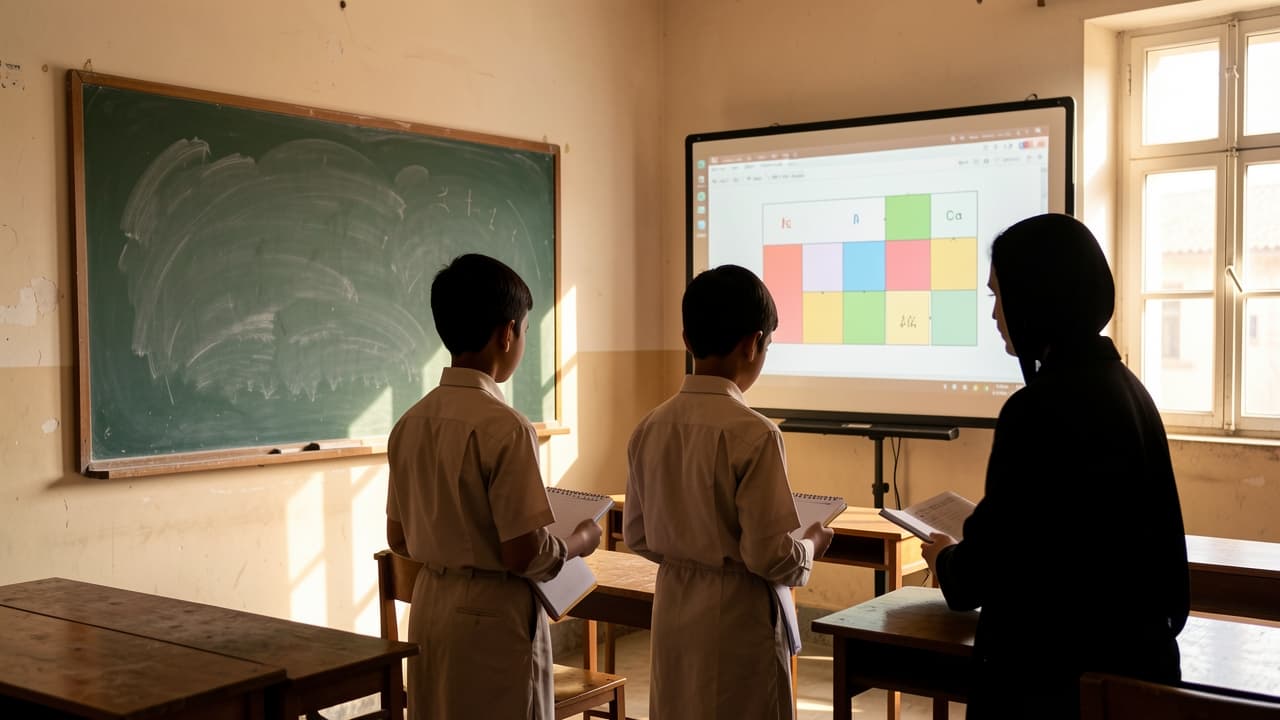
Artificial Intelligence (AI), software that can explain a problem, answer a question or help shape a piece of work, is already part of how some students in Pakistan study. For readers asking what has replaced the old routine of copying the board, The Nation reports from Islamabad that AI education in Pakistan, in the classrooms it describes, means using AI tools and smart boards for lessons, projects and missed work. Pupils say an explanation can arrive in moments, instead of a wait for a library book.
From copied notes to a second chance at the lesson
The older pattern in the report is a familiar one: the teacher wrote, the class copied, and those notes were the record of the day. Talha Khan told The Nation that missing a class used to mean missing the lesson, because the board and the teacher's notes were the only source. He said AI and smart boards now keep the material available "with one click", so a lecture can be watched again and a question asked later. The paper describes these rooms as smart learning spaces, and it frames them as a change in Islamabad classrooms, not as proof that every school has switched.
What students say the tools are for
Ayesha Khan, a 9th-class student, said she used to copy "everything from the blackboard". She now asks AI when a maths problem will not make sense at home, and she says it answers "like a teacher", with a step-by-step solution. She also uses the tools for presentations and to find pictures and videos for projects. She said students now learn by seeing and doing, and that AI is there to help them "think and create".
Talha said he uses the same kind of setup to try coding and graphic design, and that it feels like "learning for the future", not only for exams. The Nation also says students are getting help with equations, essays and presentations. Taken together, that is this report's picture of AI in education for students: two pupils in Islamabad, not a countrywide survey.
Teachers, slower learners and the limit of the report
Teachers in the piece say AI has not replaced the classroom; it has changed the work inside it. They see the focus moving from rote memorisation toward critical thinking and creativity. Ms Shazia, a teacher at Islamabad Model College, said her role has shifted from dictating notes to guiding students on how to use technology "positively and ethically". She said smart classrooms help slower learners too, because staff can give each student a task matched to their ability, which she said was not possible with the blackboard system.
The article stops there. It does not say how many schools have these boards, which products they use, or which universities teach AI. For anyone following AI education in Pakistan, the sourced account is a classroom one: help after school, lessons that can be replayed, and teachers who say they still have to show students the honest way to use the tools.