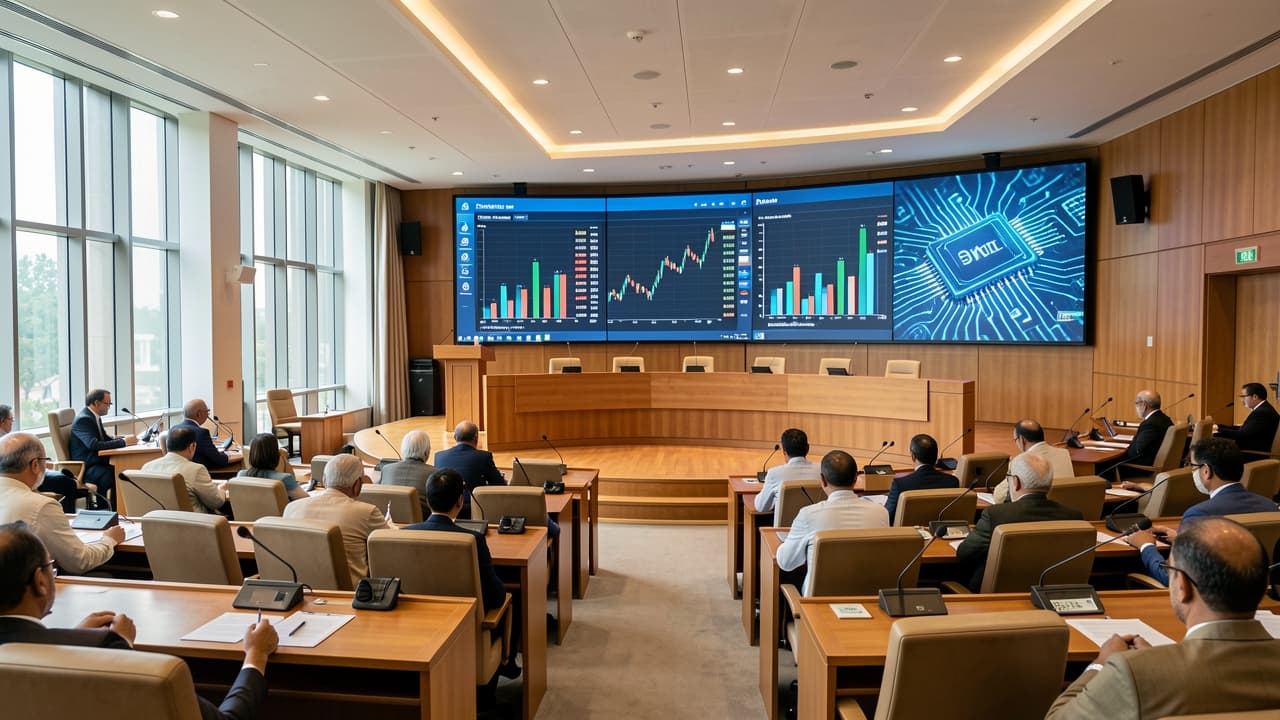
The latest IMF report on AI reveals that massive global spending on artificial intelligence infrastructure is supporting world economic activity, lifting projected global output growth to 3.1% in 2026. Released during the annual meetings of the International Monetary Fund (IMF) and the World Bank in Bangkok, the updated World Economic Outlook shows technology investment offsetting severe energy disruptions caused by the conflict in the Middle East. However, the Washington-based lender cautioned that global resilience is reaching its limits as mounting public debt and geopolitical strains leave vulnerable economies behind.
The fund's 2026 global growth forecast marks a slight upgrade from its July projection of 3.0%, though it remains lower than the 3.5% expansion recorded in 2025. For 2027, the fund projects world gross domestic product (GDP)—the total value of goods and services produced—to grow by 3.4%. While hardware-producing and platform-building nations such as South Korea, Malaysia, Mexico, and Thailand received growth upgrades, nearly 47% of world economies faced downward revisions.
AI Boom Offsets Geopolitical and Energy Shocks
The widening divergence comes with crude still above $100 a barrel because of the Middle East conflict. Gulf oil exporters face sharp contractions. Energy importers outside the AI hardware chain are the ones losing ground. A companion IMF projection, reported separately, puts Pakistan’s inflation at 9.9% in 2027 as growth slows.
On Monday in Bangkok, before Tuesday’s outlook was released, IMF Managing Director Kristalina Georgieva called the AI build-out a demand shock and an investment shock. She described AI as a “slow-moving tsunami” and said IMF research shows about 40% of jobs will be augmented, downgraded or eliminated, and about 60% in advanced economies. Tuesday’s outlook adds a downside case: if the productivity gains do not arrive and investment pulls back, global output could be 1.1% lower by 2028.
Divergence and Labor Market Disruptions
Chief economist Silvana Tenreyro said on Tuesday that the global economy’s resilience is reaching its limits, and that governments need to restore fiscal space. The outlook says 32 countries now account for 95% of global growth, compared with 54 in April. On Monday, Singapore President Tharman Shanmugaratnam said the first job after graduation is seeing less demand. World Bank President Ajay Banga said he was not convinced entry-level jobs would disappear, and that the Bank is focused on smaller AI tools for farmers, clinics and teachers.
Aasan alfaaz mein
IMF ne mangal ko 2026 ki aalmi taraqqi 3.1 feesad rakhi, jo July ke 3.0 feesad se thori zyada hai. AI ki sarmayakari tail ki mehangi qeemat ka asar kam kar rahi hai. Pakistan ki 2027 mehangai 9.9 feesad ki alag peshangoi pehle hi aa chuki hai. Peer ko Georgieva ne AI ko rozgar ke liye aahista tsunami kaha tha: taqreeban 40 feesad naukarion par asar, aur taraqqi yafta mulkon mein 60 feesad.