Pakistan loitering munitions and related naval unmanned systems will need more than cheaper warheads and more frequent tests: they also need communications that keep working when air defences and electronic warfare try to cut the link. In an October 2026 interview, Pakistan Navy Chief of Naval Staff Admiral Naveed Ashraf described an interconnected Naval Air Arm built on manned-unmanned teaming (crewed and uncrewed craft working together), artificial intelligence, sensor fusion, and a mesh network—priorities framed as “capability” rather than platform counts.
Fiscal limits make that framing practical. Pakistan cannot rely only on buying new ships or aircraft to strengthen its posture. Networking, software and munitions survivability are presented as relatively accessible steps compared with major new platforms, while still changing how strikes and sensors work in a fight.
Why mesh links matter for munitions and the fleet
A mesh network is a radio web in which every node can send, receive and relay traffic for others, without depending on a single central station. Militaries often call these mobile ad hoc networks (MANET) because the nodes move and the network forms itself around them. If one node is destroyed, jammed or moves out of range, the rest can route data around the gap.
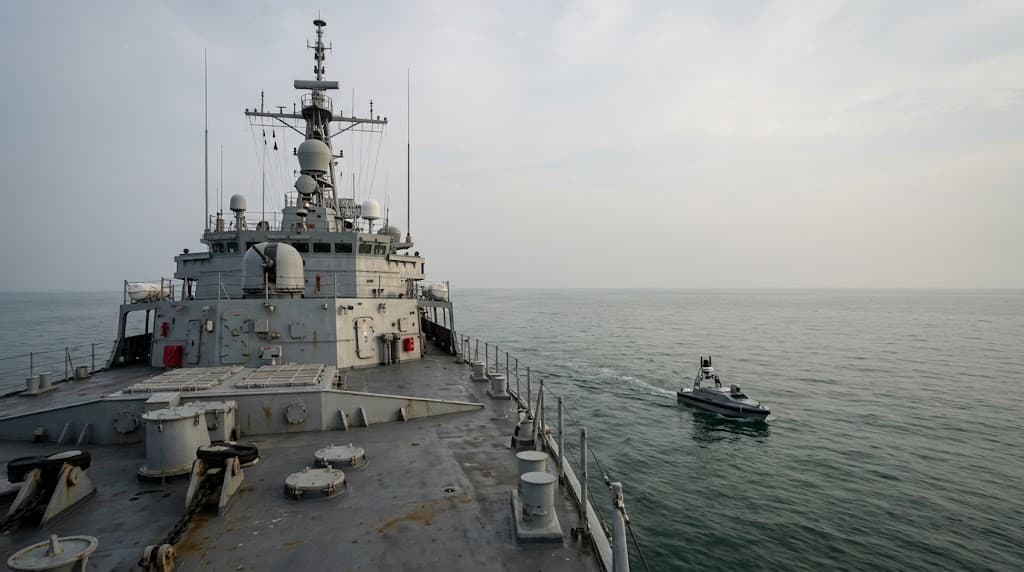
At sea, those nodes can include ships, maritime patrol aircraft, helicopters, drones, unmanned surface vessels and shore stations. A low-flying drone, for example, can relay signals from an unmanned surface craft that sits beyond the controlling ship’s radio horizon. That same logic feeds discussion of Pakistan loitering munitions and other precision-guided munitions (PGMs): weapons and sensors must not only be numerous; the strike must still land when the opponent fields a dense integrated air defence system (IADS) and heavy electronic warfare (EW).
India’s air-defence and EW density is treated as a standing planning assumption. Lessons drawn from recent wars elsewhere point the same way: scale without survivability is incomplete. NESCOM—the National Engineering & Scientific Commission, Pakistan’s main munitions and unmanned systems developer—had been weighing viability in IADS- and EW-dense environments before 2024, alongside the push for simpler designs and more frequent PGM testing.
What the Navy already has—and what still lags
From a hardware view, much of the foundation for a mesh-enabled force is already visible. The Navy operates long-range maritime patrol aircraft, multi-mission naval helicopters, an indigenous tactical data-link known as Link Green, and a growing mix of sea- and shore-based long-range missiles, plus a clear interest in drones.
NESCOM is leading unmanned work for the Navy through Shahpar-3 (UAV, or aerial drone), Muhassir (USV, surface drone) and Israr (AUV, underwater drone). Shahpar-3 development is still ongoing, so the full unmanned stack is not yet fielded at scale. New crewed platforms such as the Sea Sultan long-range maritime patrol aircraft have also yet to enter service. Wider manned-unmanned teaming, sensor fusion, AI use and mesh networking are therefore expected to follow those inductions in the short-to-medium term.
Those requirements translate into demand for edge radios, drone-control software, sensor-fusion tools and related products from both domestic and foreign suppliers—an opening for firms that can meet Pakistan military technology needs without waiting for another large platform purchase.
Timeline: what has happened so far
- Before 2024: NESCOM is described as already examining how PGMs and related systems stay viable in dense IADS and EW conditions.
- Ongoing: Pakistan’s PGM effort emphasises scale through more frequent testing and simpler munitions designs.
- Ongoing: NESCOM works on Shahpar-3, Muhassir and Israr; Shahpar-3 and the wider unmanned stack are not yet deployed at scale.
- Ongoing: Sea Sultan long-range maritime patrol aircraft induction remains pending.
- October 2026: Admiral Naveed Ashraf outlines a Naval Air Arm vision centred on manned-unmanned teaming, AI, sensor fusion and mesh networking.
Aasan alfaaz mein
Pakistan Navy ab aise radio networks chahti hai jahan har jahaz, drone ya aircraft doosron ka message aage bhej sake. Agar ek link toot jaye ya jam ho jaye, baqi nodes data ghumaa kar pohancha den. Is se loitering munitions aur naval drones dense air defence mein zyada reliable ho sakte hain. Bade naye platforms se pehle yeh software aur radio capability sasti aur tezz raasta maani ja rahi hai.