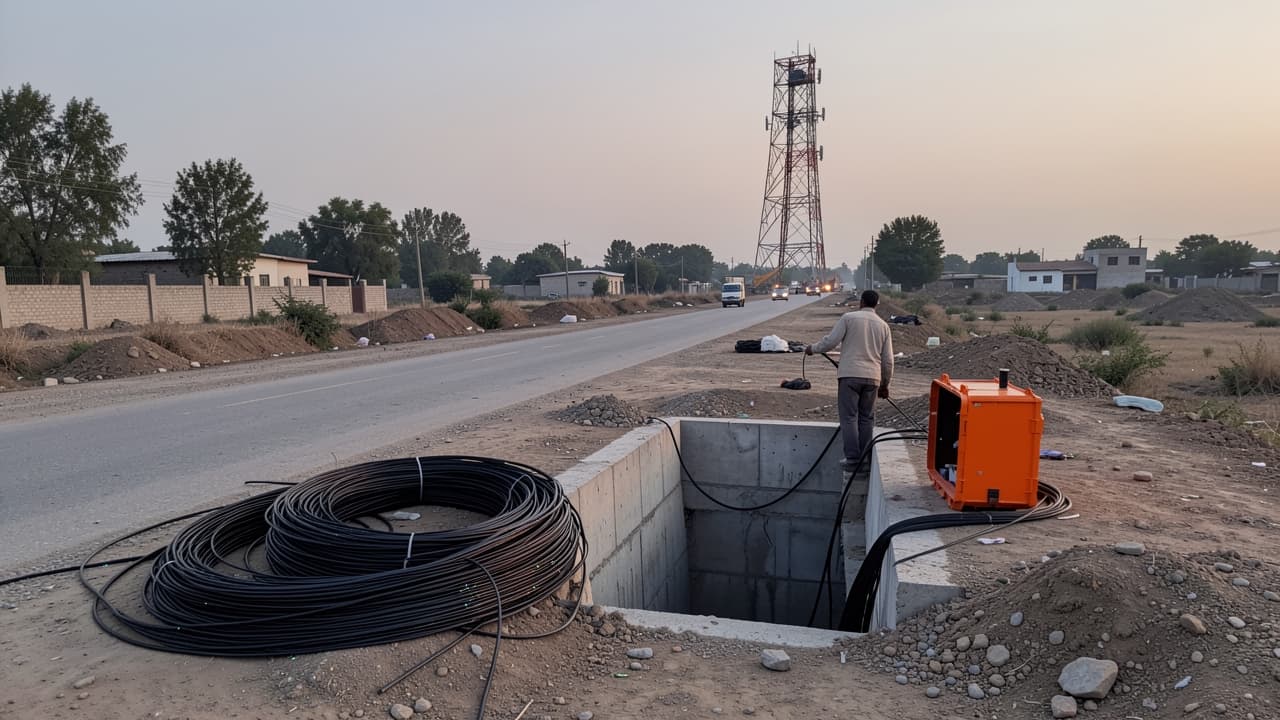
Pakistan's digital subsidies have moved past $1.054 billion, a total shared when a regional telecom meeting opened in Islamabad on Tuesday. The Universal Service Fund, public money that pays for phone and internet links where private firms would not build alone, has put in upwards of 17,000km of fibre-optic cable. Addresses at which a fibre line can be sold to a household climbed from a 2024 starting point beneath three million to a present figure above five million.
The Asia-Pacific Telecommunity, an intergovernmental forum for the region, is co-hosting the symposium alongside Pakistan's IT and telecom ministry and USF Pakistan. Ministers, regulators and company chiefs from around the region have joined. States taking part are expected to draw up a new universal-service approach over the three-day sitting, one that leans less on plain voice support and bare coverage and more on gigabit-class fibre, satellites, help to buy handsets, and machines for artificial intelligence in rural districts.
Minister sets out who is still offline
Shaza Fatima Khawaja, the federal IT and telecom minister, spoke at the opening in the role of chief guest. She put the offline population at about 2.2 billion worldwide and, in Asia and the Pacific, close to 48 percent, a share she ranked above the global level. A working connection, she argued, is now essential for school, treatment, coping with disasters and the defence of the country. She added that Prime Minister Shehbaz Sharif goes over the National Connectivity Plan on a cycle of 15 days.
Network build still trails the 5G aim
Mobile towers joined to fibre have moved from 15 percent to a level past 19 percent. Fifth-generation mobile service, or 5G, depends on fibre reaching 60 percent of towers at a minimum. Placed against that floor, the current share leaves the great majority of masts still waiting on a fibre feed.
A licensing framework for fixed satellite services, meaning satellite links tied to one place, is close to done. Across a 2.5-year span, three additional cables under the sea have come ashore in Pakistan. GSMA, the worldwide group for mobile operators, says Pakistan narrowed the mobile-internet gap between women and men faster than any country in a two-year spell, with the gap moving from 38 percent down to 8 percent.
Homegrown business owners are receiving CVAS licences, which let a firm sell extra services on top of basic telecom. Fuel assistance, sent through a software-based arrangement, reached in excess of 10 million users, and owning a handset was not required.
The chief executive of USF Pakistan, Chaudhry Mudassar Naveed, reported that 158 schemes in a portfolio of 185 are finished. Outlay on that work has gone beyond Rs169 billion, and the beneficiary total stands above 38.4 million.
Masanori Kondo, secretary general of the APT, said the divide in digital life now appears as poor quality and as a shortage of readiness to use online services. He said funds meant to spread access should be recast so performance is judged by results.
What delegates will debate next
The Tokyo Statement 2025 supplies the reference for four lines of work: speeding gigabit broadband, taking on emerging tools, finance and governance built to last, and joint effort by public bodies, firms and users. Later meetings are set to examine 5G preparedness, fibre that competitors can share, permits for laying lines along routes, solar gear for greener sites, wider digital participation by women, whether villages can host computing for AI, how to protect cables beneath the ocean, and warnings issued before a hazard strikes. Also present was Hafeezur Rehman, who chairs the Pakistan Telecommunication Authority, the body that regulates phones and internet services.
Timeline: what has happened so far
- 2024: The number of homes a fibre line could pass sat below three million.
- 2.5-year span: three further submarine cables landed.
- Two-year span cited by GSMA: the mobile-internet shortfall for women versus men fell from 38 percent to 8 percent.
- 2025: The Tokyo Statement set the themes guiding the symposium.
- Tuesday: The APT meeting opened in Islamabad, and digital subsidies were put above $1.054 billion, with tower fibre past 19 percent against a 60 percent 5G marker.
Aasan alfaaz mein
Pakistan ki digital subsidies $1.054 billion se upar pohanch chuki hain. Mulk mein 17,000 kilometre se zyada fibre lag chuki hai, aur gharoun tak broadband 2024 mein teen million se kam se ab paanch million se zyada ho gayi hai. Mobile towers par fibre qareeb 19 percent hai, jabke 5G ke liye kam se kam 60 percent chahiye. Aam logon ke liye behtar internet ki ummeed hai, lekin 5G abhi door hai.