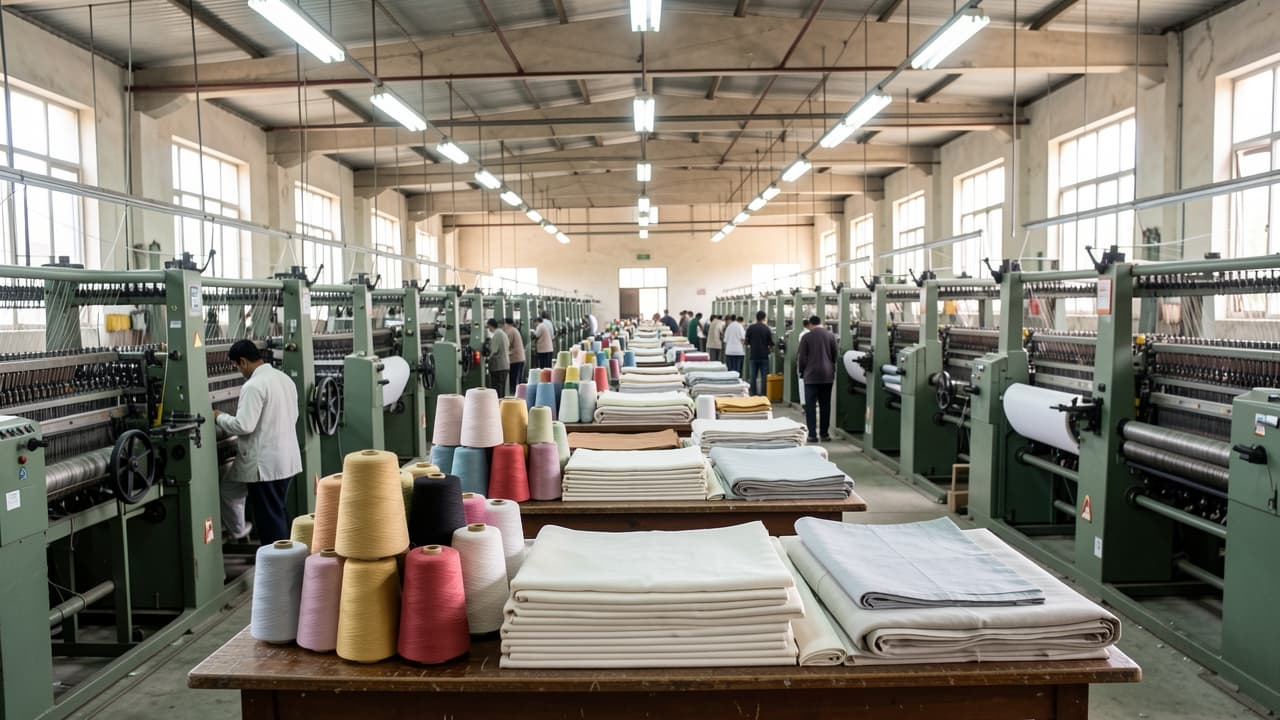
Pakistan’s top 20 listed textile companies earned Rs51.9 billion together in fiscal year 2026, 11% more than a year earlier, Topline Securities said. Textile industry profit in Pakistan at this group rose even though the firms sold almost the same amount of goods. Most of the improvement came from cheaper borrowing and a lower tax rate.
Sales totalled Rs1.4 trillion, about $5 billion, and were largely unchanged. They slipped 0.3%, and gross profit slipped 0.2%. Gross margin, the share of sales left after production costs, stayed at 13.1%. These 20 firms account for 83% of the stock-market value of the listed textile group Topline reviewed.
Why profit rose while sales stood still
Finance costs fell 19% to Rs54.5 billion. Topline tied that fall mainly to lower financing rates and to reduced borrowing under the Export Finance Scheme, a loan scheme for exporters. The effective tax rate, tax as a share of profit, dropped to 33.2% from 37.1%. The brokerage said the drop came mostly from reversals of deferred tax after a change in the future treatment of super tax, an extra levy, for exporters.
The accounts show a business that did not grow what it sold. It kept more of each rupee because financing and tax took a smaller share. Gross profit was slightly weaker even as the final profit moved higher.
Interloop, Sapphire and Nishat
Interloop, Sapphire Textile Mills and Nishat Mills made 48% of textile sector profit in this listed group. The three did not move together.
Interloop’s consolidated profit, counting its subsidiaries, surged 129% to Rs12.7 billion. Topline credited better gross margins, lower finance costs and a sharp rise in other income. Sales increased 5% to Rs187.7 billion.
Sapphire Textile Mills’ unconsolidated profit, the parent company alone, rose 73% to Rs6.8 billion even though sales fell 13% to Rs81.2 billion. Higher other income, lower finance costs and a lower tax rate drove the result.
Nishat Mills’ unconsolidated profit fell 9% to Rs5.5 billion. Topline linked the fall to lower dividend income and narrower gross margins. Sales still rose 2% to Rs181.6 billion.
Exports and the year ahead
Pakistan’s textile exports reached a record $17.6 billion in FY26, up 2% from a year earlier, and made up 57% of the country’s goods exports. Value-added textile exports, finished products rather than basic yarn or cloth, rose 3% to $13 billion.
Topline expects measures in the fiscal 2027 budget, and financing costs that remain lower, to support textile industry profit in Pakistan. It also said firms are shifting toward renewable energy and other cheaper power to manage energy bills and stay competitive. High energy costs are still the main near-term challenge. Uncertainty over GSP+ status, the European Union scheme that reduces duty on many Pakistani exports, and a possible slowdown in the United States and Europe are the other risks Topline named.
Aasan alfaaz mein
Bari listed textile companies ka mila kar munafa FY26 mein 11 percent barh kar 51.9 arab rupay ho gaya. Sales lagbhag wahi rahi; munafa is liye barha ke qarza sasta para aur tax kam laga. Textile exports record 17.6 arab dollar tak pahunch gayin, jo mulk ki goods exports ka 57 percent hain. Mehengi bijli ab bhi mills ke liye sab se bara masla hai.