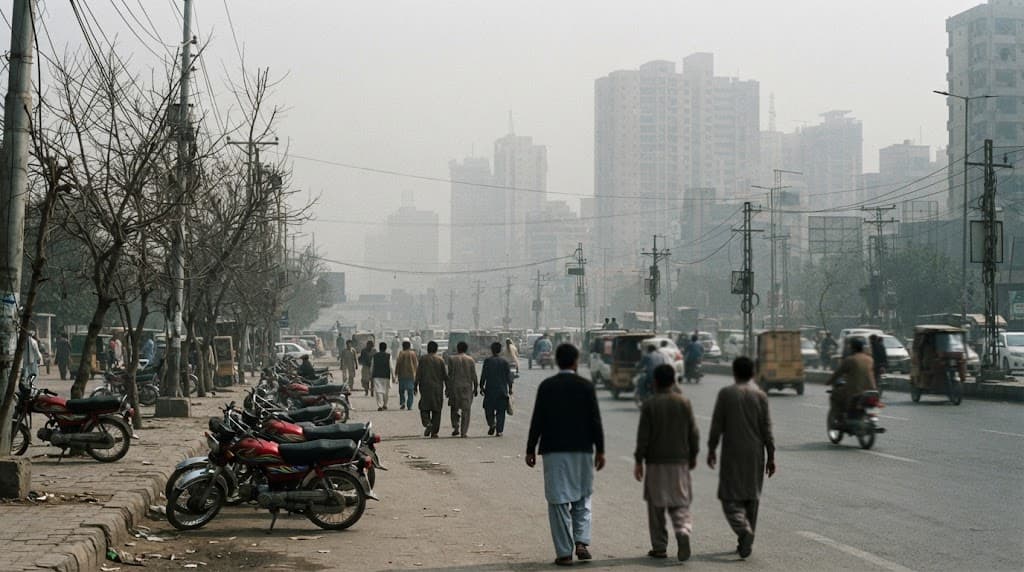
Toll on lives and the economy
Dirty outdoor air is linked to more than 200,000 fatalities each year in Pakistan and can wipe out as much as 6.5 percent of national economic output, speakers warned on Wednesday at the Pakistan National Clean Air Conference 2026 in Islamabad. They pressed for joint work across governments, tighter tracking of emissions and lasting finance to tackle what they framed as both a health emergency and an environmental one.
A UNICEF briefing underlined how heavily the burden falls on the youngest. It linked 56,725 deaths of children younger than five in 2023 to polluted air and put healthy life-years lost for that age group at 5.1 million. Citing the State of Global Air Report 2025 and the Global Burden of Disease 2023 study, the briefing said every resident lives where yearly average fine particles (PM2.5 — tiny soot that enters the lungs) sit above Pakistan’s own ceiling of 15 micrograms per cubic metre. About 92 percent face averages above 35 micrograms. In Punjab and Khyber Pakhtunkhwa alone, 76.6 million children breathe air above the World Health Organisation’s loosest interim goal of 35 micrograms.
Cindy Kushner of UNICEF Pakistan pointed to damage for child survival, wellbeing and schooling. She recalled that haze in November 2024 forced classroom shutdowns across 18 Punjab districts and disrupted learning for 16 million pupils. She listed winter haze, field burning, extreme heat and monsoon flooding as repeated risks to children’s lives and education.
Partners and the “35 by 35” goal
Officials and aid partners used the meeting to discuss rolling out the National Clean Air Policy in the capital territory, the provinces, Azad Jammu and Kashmir and Gilgit-Baltistan. In a partnerships session chaired by Islamabad EPA chief Syed Ibrar Hussain, World Bank country director for Pakistan Bolormaa Amgaabazar said South Asia accounts for two million of seven million early deaths tied to polluted air worldwide and hosts nine of the ten dirtiest cities on Earth.
She said the bank’s decade-long plan seeks a 35 percent drop in Pakistan’s pollution by 2035 — labelled “35 by 35”. She pointed to Punjab’s $300 million Clean Air Programme inside a wider $1.26 billion effort spanning five countries along the Indo-Gangetic Plain and Himalayan foothills. That province-led scheme includes a Green Building hub with live screens that follow pollution readings. Priorities she named included focused health spending, private investment in cleaner kit and deeper ties among states, donors and citizens.
GIZ Pakistan country director Maria-Jose Poddey argued that stand-alone schemes fail without matching money, skilled agencies and joined-up work, and that progress should be judged by healthier air and communities, not by how many projects are announced. Asian Development Bank country director Xiaoqin Fan noted that China and Mongolia cut PM2.5 by roughly half over five to six years when governments stayed the course with partner support. She said ADB help can stiffen coordination, rules and oversight, with each donor dollar potentially unlocking five to six more from elsewhere.
UNICEF deputy representative Hamida Ramadhani urged planners to weave clean air and climate steps into energy, transport, building and farming plans from the start, with open data, tougher enforcement, cleaner schools and homes, prevention and more youth roles in green work.
National plan and Punjab steps
Pakistan EPA director Dr Mohsina Zubair said an action blueprint with 90 measures in eight fields — farming and forests, diplomacy, power, factories, mobility, cities and waste — is ready. Guidance is being drafted so provinces can set baselines, weigh health harm, pick targets and write plans. The agency is working with provinces on a Clean Air Secretariat and has sought a $3 million to $5 million Climate and Clean Air Coalition grant. A Clean Environment Fund fed by fees and fines would help pay for work. Other aims include reviewing energy, transport and petroleum rules, aligning national quality standards with WHO’s 2021 air guidelines and building a shared data platform.
Punjab described progress under its World Bank-backed scheme. Azad Akram of the programme team said setup finished in three to four months after March board approval, with the programme live from June 2025. Plans cover buying out 900 high-emission vehicles, 225 of them by June. To cut stubble fires, 5,000 super seeders sit in a subsidy where the province covers 60 percent of cost and growers 40 percent; 4,800 machines were already distributed before haze season. Users also get a Rs5,000-per-acre rental subsidy aimed at 1.2 million acres. Six hundred electric buses are being acquired — 400 already in procurement — with arrivals expected in March or April.
Timeline: what has happened so far
- 2023: UNICEF links 56,725 under-five deaths in Pakistan to polluted air.
- November 2024: Smog closes schools in 18 Punjab districts, affecting 16 million children.
- March 2025: World Bank board approves Punjab’s clean-air programme.
- June 2025: The Punjab programme becomes effective after a short setup period.
- 28 October 2026: National Clean Air Conference speakers cite 200,000-plus yearly deaths and GDP losses up to 6.5%.
- By 2035: World Bank strategy targets a 35% cut in Pakistan’s air pollution.
Aasan alfaaz mein
Pakistan mein ganda hawa har saal do lakh se zyada logon ki maut se juda bataya gaya. Bachon par asar bohot gehra hai, aur pora mulk PM2.5 ki qomi had se upar rehta hai. Hukumat aur World Bank jaise shuraka Punjab mein buses, machines aur monitoring pe kaam kar rahe hain. Saaf hawa ke liye lagataar paisa, qanoon aur mil kar amal zaroori hai.