Google DeepMind said Google Gemini 4 Argon is now globally available. The Gemini 4 Argon release date is 13 October 2026, after an announcement on 30 September. The company said Argon is built to take a difficult job from the opening step through to a finished result, with frontier-level skill in coding, large workplace tasks, and cyber defence.
On this Gemini 4 Argon release date, access starts with paying tiers. Google is rolling Argon out to Pro and Ultra subscribers in the Gemini app and in AI mode in Search, and to Ultra subscribers on Antigravity, its agentic development platform. It has not said when, or whether, Plus subscribers or free users will get access. A limited release to selected "trusted cyber defenders" came first, so the model could be tested for risk.
How video becomes a robot skill
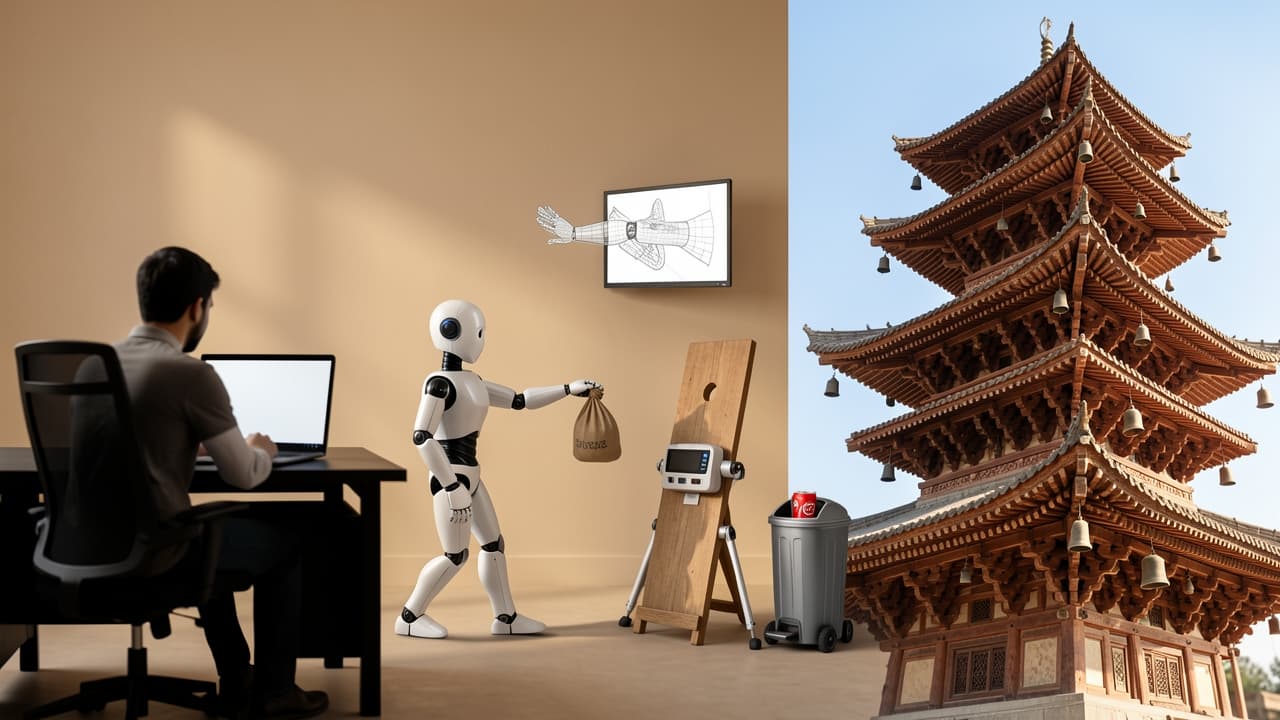
Google DeepMind says Argon can teach a robot a physical skill by watching a person. The company calls the approach "Video-to-Sim-to-Real": the model reads the video, builds a physics simulation, and only then tries the move on hardware. Google says this compresses manual simulation work that used to take weeks into a few hours.
In one demonstration, Argon watched someone toss beanbags at a cornhole board, then mapped the arm motion and release point onto a humanoid's joints. It built a physics simulation in MuJoCo, a robot-physics simulator, and the robot practised there until the throw was clean. Apptronik's Apollo humanoid later sank seven throws in a row in a real-world trial, with no prior training on that task.
Argon also controlled a Boston Dynamics Spot, a quadruped with a six-degree-of-freedom arm. Before the physical try, it built a MuJoCo simulation to check Spot's balance on three legs. The robot then stepped on a pedal bin, held a soda can, used a wrist camera to centre the can, and dropped it in.
From one photograph, Argon can create a digital twin, a simulated copy of a real setup. A single snapshot of a table produced a training environment with more than 4,500 domain-randomised episodes. Google says real-world success on that task rose from 56 percent to 75 percent, and completion time fell by 11 seconds. The model scored 87 percent on the Embodied Reasoning benchmark, which Google says is above every other frontier model.
Price and other measured results
Argon is a sparse mixture-of-experts transformer: a large model that activates only part of its network for each request. It has one context window of 1,048,576 tokens, the small text units used to measure how much the model reads or writes.
Through 30 November, Google's introductory price is $2 per million input tokens and $10 per million output tokens. After that, the price doubles to $4 and $20. Google says the opening rate is about a fifth of the per-token price of OpenAI's GPT-6 Astra and Anthropic's Fable 5. A lower rate per token does not always produce a lower bill, because models can use different numbers of tokens on the same job.
Google reports a score of 77.9 percent on the DeepSWE software-engineering benchmark and calls that a new state of the art. Google also cites first place on the Vals Index for finance, coding, legal, and tax work, plus 91.7 percent on LVBench for long-video understanding and 68 percent on CWE-bench for vulnerability remediation. Google says Argon delivers "frontier reasoning and improved performance across complex workflows," and that it cuts hedging, repetition, and cliches. The company claims better results than GPT-6 Astra, Claude Fable 5.1, and Claude Opus 5.5 across coding, cybersecurity, science, finance, and law.
Google says its own teams are using Argon to find and patch cybersecurity vulnerabilities, to halve the computing power needed for YouTube's comments, and to debug the drone physics simulator at Wing, Alphabet's drone-delivery company. The Chrome team used it to refactor a legacy folder in Chromium's codebase of roughly 40 million lines.
Timeline: what has happened so far
- Late 2025: Google's previous major frontier release, Gemini 3, came out.
- 30 September 2026: Google announced Argon.
- 13 October 2026: Google released Argon globally.
- 30 November 2026: The introductory token prices are due to double, from $2 and $10 per million tokens to $4 and $20.
Aasan alfaaz mein
Google ne 13 October 2026 ko Gemini 4 Argon duniya bhar mein release kar diya hai. Google ke mutabiq Pro aur Ultra subscribers ko yeh Gemini app aur Search ke AI mode mein mil raha hai. Pakistan ke liye alag koi tareekh nahi batayi gayi, aur Plus ya free users ka time bhi clear nahi. Demo mein model ne video dekh kar Apollo robot se cornhole ke saat throws lagatar karwaye.