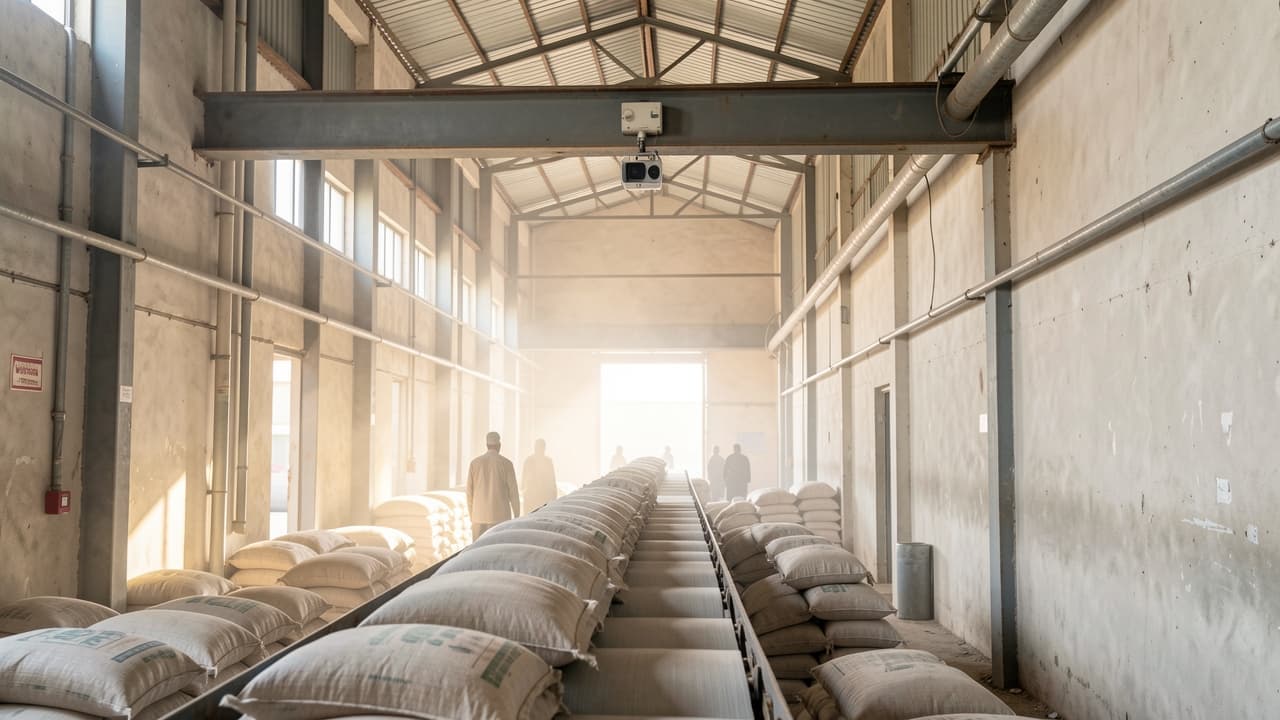
Camera checks on factory output must cover Pakistan's manufacturing by the end of this year. Prime Minister Muhammad Shehbaz Sharif gave that direction on Monday to the Federal Board of Revenue (FBR), the federal tax authority, while chairing a review of FBR reforms in Islamabad. The system is for sales tax. Cameras are meant to record what plants produce so tax charged on those goods can be set against output. The meeting was told that production monitoring through cameras, under the faceless taxation system, was being made more effective. Faceless taxation is the practice of handling tax work with less direct contact between officers and taxpayers. In the Prime Minister's Office Media Wing account, the project is cameras and automated equipment. That account does not describe an FBR digital invoicing system.
The Media Wing said Shehbaz Sharif ordered officials to remove obstacles to installing the automated systems. He warned that businesses which take tax from consumers and keep it, instead of paying it into the government exchequer, did not deserve any concession. Collecting tax up to the country's full revenue potential was, he said, "a meaningful service to the public."
Where the cameras stand
The briefing said the system is already fully installed in the sugar, cement, tobacco, tiles and fertilizer sectors. Work is still going on in textiles and in packaged water, packaged juice and packaged milk. Equipment for those sectors has been procured.
Equipment for steel, poultry and the tyre sector is to be procured by 15 October. Procurement for tea, household electronics, leather, paper and board, and oil and ghee is to be finished by 30 October. The meeting was told the system was expected to be fully operational across all these manufacturing sectors by 31 December.
People looking up the FBR digital invoicing system will not find a fresh invoicing rule in that schedule. The schedule is for monitoring kit on production lines.
Firms that complied, and the revenue gap
Shehbaz Sharif was told that several industries had resisted installing monitoring systems in textiles. He appreciated companies that had fitted them voluntarily and in line with government measures: Nishat Mills, Alkaram Textile, Alkaram Cotton Mills, J.K. Spinning Mills, Surti Enterprises, Interloop Limited, Faisal Spinning Mills, Ibrahim Fibres Limited, Sapphire Textiles Limited and Nishat Chunian. He said the government would do what was required to reach the country's full tax potential, and he praised manufacturers that were installing systems on their own.
He commended the FBR Transformation Team for a broad assessment of tax potential in the production sector, and for the audit report on cement. He asked the Ministry of Information Technology to audit the system in other sectors and judge how well it works. He also praised the team's round-the-clock efforts. Ministers Azam Nazeer Tarar, Dr Musadik Malik, Ahad Khan Cheema and Shaza Fatima Khawaja were present, with Minister of State Bilal Azhar Kayani, adviser Haroon Akhtar and senior officials.
The meeting was also given a review of the gap between tax collected and the country's tax potential, including revenue that better compliance and enforcement could bring. Officials said government measures had brought an additional Rs1.3 trillion over the past three years, a 40 percent rise in tax collection, generated through enforcement.
Timeline: what has happened so far
- Over the past three years, officials said, enforcement added Rs1.3 trillion to tax collection, a rise of 40 percent.
- 12 October: Shehbaz Sharif, at an FBR reforms meeting in Islamabad, ordered production monitoring finished across manufacturing by year-end and told officials to clear installation obstacles.
- 15 October: Procurement of equipment for steel, poultry and tyre is due.
- 30 October: Procurement for tea, household electronics, leather, paper and board, and oil and ghee is due.
- 31 December: The monitoring system is expected to be fully operational in the sectors named at the meeting.
Aasan alfaaz mein
Prime Minister Shehbaz Sharif ne FBR ko kaha hai ke factoryon ki paidawar dekhne wala system is saal ke akhir tak mukammal ho. Cameras yeh dekhenge ke mill kitna maal bana rahi hai, taake sales tax ka hisaab ho sake. Cheeni, cement, tambaku, tiles aur fertilizer mein yeh system lag chuka hai. Jo karobar tax logon se le kar sarkar ko jam nahi karta, us ke liye koi rayat nahi hai.