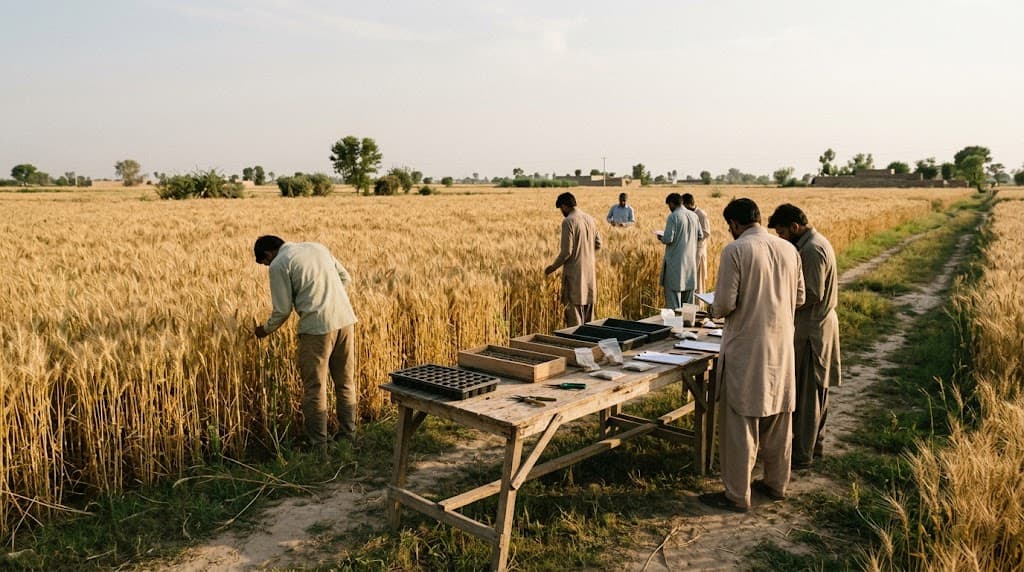
Pakistan’s minister for food security has called for closer work with CIMMYT — the international maize and wheat research centre — to raise wheat production, close the country’s yield gap and eventually build a surplus that can be exported.
Rana Tanveer Hussain made the appeal at a meeting in the Ministry of National Food Security and Research with Dr Flavio Breseghello, director of CIMMYT’s Global Wheat Program, and Dr Sajid Ali, CIMMYT’s senior scientist and country representative for Pakistan. He said the country must go beyond self-sufficiency and develop the ability to supply international markets and food-deficit nations.
Yield gap, imports and a 3.5-tonne target
With a population of around 260 million, Hussain said wheat production had to rise substantially. Pointing to the recent need for wheat imports, he argued that better seed, stronger research and wider use of modern farm technologies were essential to fix the productivity shortfall.
He highlighted a wheat yield target of 3.5 tonnes per hectare and called for more engagement with private partners in support of national food security. Research partnerships and practical innovations, he said, would matter more as farmers face higher input costs and the effects of climate change.
The minister asked CIMMYT to expand its help on improved crop varieties, genomic research, hybrid wheat, gene-editing tools and advanced breeding. He also stressed the need for stronger research facilities and better-trained scientists so that new varieties can withstand climate pressure and offer better nutritional value.
Six decades of partnership and recent CIMMYT work
Acknowledging about sixty years of CIMMYT–Pakistan cooperation, Hussain credited the organisation’s historic role in agricultural development, including MAXIPAK varieties linked to Pakistan’s Green Revolution. Future work, he said, should lean harder on advanced technologies that can still lift yields.
He welcomed CIMMYT’s backing for upgraded laboratories, research equipment and machinery for agricultural research institutions. Dr Sajid Ali told the meeting that facilities at five major wheat research centres had been upgraded during 2026, including the National Agricultural Research Centre in Islamabad, and that research machinery had gone to 11 national partners.
Fifteen scientists had received training in Kenya, Nepal, Ethiopia and Mexico, with further programmes inside Pakistan, he said. CIMMYT had also helped set up 21 seed banks across 20 districts in Punjab, Sindh, Balochistan and Khyber Pakhtunkhwa, including the merged districts, aimed at resource-poor and vulnerable farming communities. Climate-smart zero-tillage seed-cum-fertilizer drills had been shared with five partner organisations, among them the Green Pakistan Initiative and the National Rural Support Program.
Hybrid wheat and a Host Country Agreement
Dr Breseghello underlined Pakistan’s long partnership with CIMMYT and the role of genetic improvement in sustained yield growth. Ongoing support, he said, is meant to strengthen breeding programmes, improve seed processing and field research, and speed up varieties suited to changing climate and nutrition needs. Both sides discussed hybrid wheat and deeper collaboration with Pakistani research bodies and other partners.
Hussain assured the visitors of continued government facilitation and said a more substantial CIMMYT role in Pakistan’s agriculture would be welcome. Officials noted that a proposed Host Country Agreement had been finalised and was ready for signing. The minister restated the government’s commitment to research, innovation and climate resilience so that cooperation with CIMMYT can help close the wheat productivity gap and improve long-term food security.
Aasan alfaaz mein
Wazir-e-khurak ne CIMMYT se mazeed madad maangi hai taake Pakistan mein gandum ki paidawar barhe. Target yeh hai ke ek hectare se 3.5 ton gandum mile, taake import kam ho aur baad mein export bhi ho sake. Behtar beej, lab upgrade aur kisaan training is ka hissa hain. Host Country Agreement ab signing ke liye tayyar bataya gaya hai.