Data center air pollution in Texas could rise sharply as new facilities are built, according to modelling by the Houston Advanced Research Center (HARC), a regional research group. If all planned projects were connected to the state's electricity grid and powered by the expected mix of sources, soot from the power sector would more than triple within five years. The group says that level of pollution would be enough to erase decades of progress on air quality. The outcome depends largely on whether developers and utilities meet the huge demand for power with gas turbines or with renewable energy.
What the Houston model projects
Soot, or fine particle pollution, is made of tiny particles that can travel deep into the lungs. In the same scenario, smog-forming nitrogen oxides, known as NOx, would rise 136 percent, approaching levels seen in 2004. Carbon dioxide, the main greenhouse gas behind global warming, would climb 90 percent above its 2025 level. The model tests three different projections for data center energy demand, so the numbers describe a range of possible futures rather than a single forecast.
Many proposed projects are speculative and could fall by the wayside. Developers can also reduce a data center's environmental footprint by building solar and wind farms on site. The HARC scenarios are conditional, which means they show what could happen under specific choices rather than what is certain to happen.
Why the power source matters
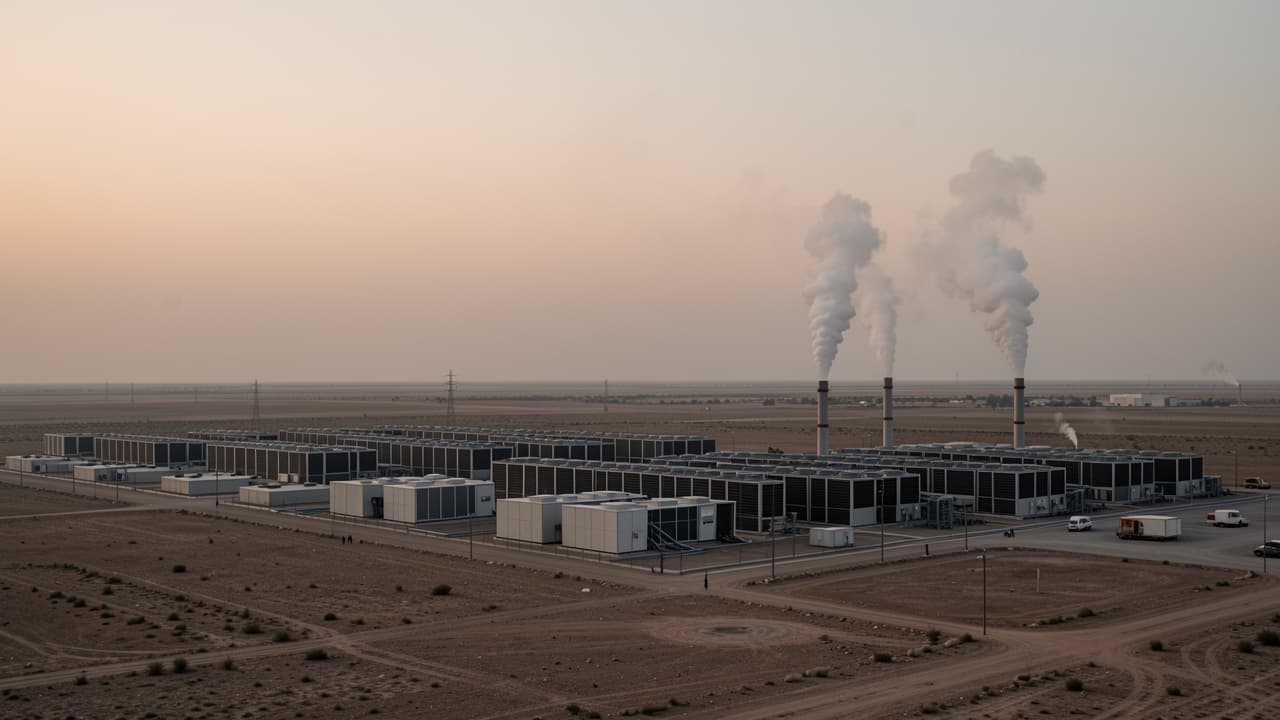
The sharpest contrast in the model is between two power choices. If developers pair grid electricity with renewable power generated on site, NOx emissions could be up to 10 times lower. If they instead build gas engines on site to avoid long waits for a grid connection, the model suggests the opposite could happen, with pollution reaching the highest levels possible.
Texas is the leading data center market when measured by how much power the facilities draw, with 26 gigawatts of existing and under-construction capacity. A gigawatt is one billion watts. A separate study by the consultancy Wood Mackenzie, published in March, found that Texas is bracing for four times more proposed data center capacity running on onsite power than any other state. Many developers are turning to less efficient gas turbine technology because it can be built faster.
What happens next
John Hall, HARC's chief executive, said in a press release that there is “a good chance” children and grandchildren will breathe dirtier air than earlier generations did. He said transport, state agencies and other stakeholders have spent decades cutting emissions, and that this progress is now at risk. His remarks reflect the group's view, and the figures are projections rather than measurements of current air.
Whether data center air pollution follows the high or low path will depend on which projects are actually built and how they are powered. For now, the numbers are a warning from modelling, not a measured change in Texas air, and the outcome is still open.
Aasan alfaaz mein
Texas mein naye data centers ki bijli ki zaroorat tezi se barh rahi hai. HARC ke model ke mutabiq agar zyada tar bijli gas se aayi to soot 2006 ke baad sab se unchi satah tak ja sakta hai. Agar developers renewable bijli apne saath lagayein to NOx kaafi kam ho sakta hai. Aam logon ke liye iska matlab hai ke hawa ki saafi is baat par bhi munhasir hai ke bijli kahan se aati hai.