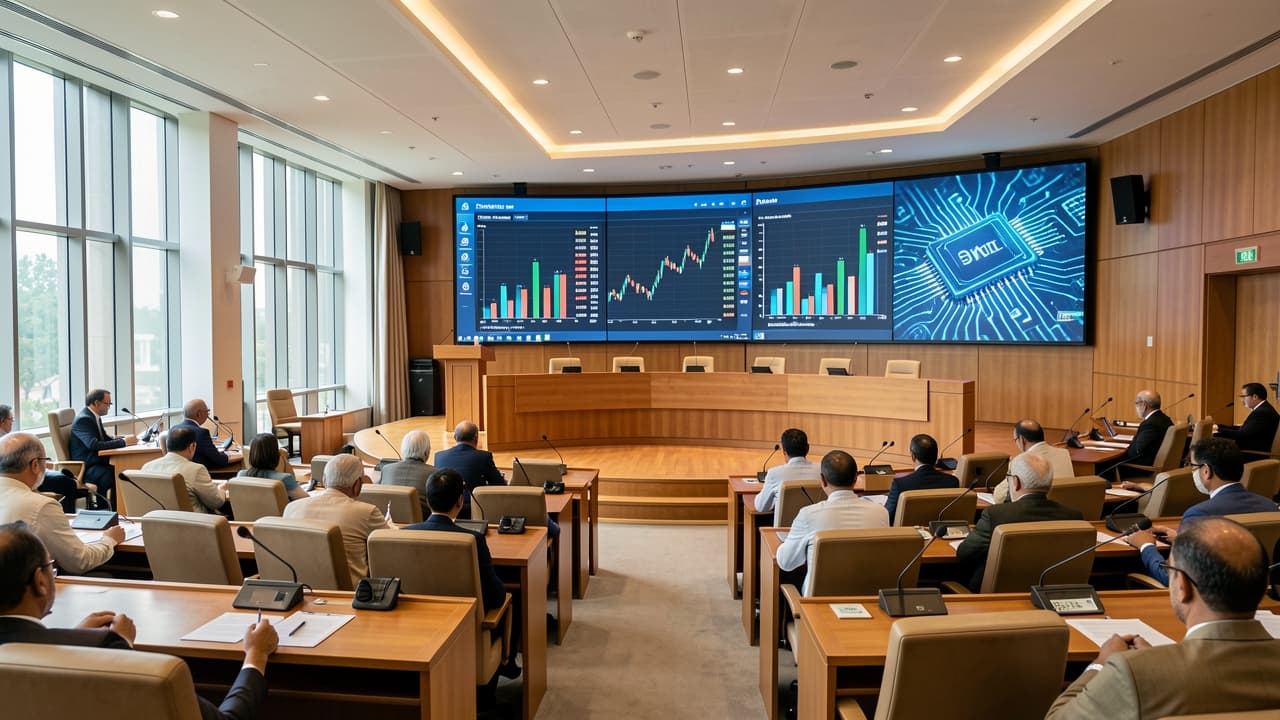
Policymakers gathered in Bangkok for the IMF–World Bank Annual Meetings said this week that the artificial intelligence boom has supported global growth—yet IMF AI economic risks remain if investment in the technology weakens. Spending on data centres and microchips has been a main force behind that boom, according to discussion at the meetings.
How AI has supported recent growth
The International Monetary Fund (IMF)—the global lender that monitors countries’ economies—said AI-related outlays have helped cushion the economic shock from rising worldwide energy prices tied to war in the Middle East. The fund’s chief economist, Silvana Tenreyro, noted that global trade rose 8.3 per cent between 2023 and 2025. Without AI-related products, she said, that figure would have been closer to 4.6 per cent.
Bank of Canada Governor Tiff Macklem described AI as pervasive. “It is everywhere in the global economy,” he said, adding that it shows up in GDP, the stock market and the bond market, and that “it is here, and it’s just the beginning.”
Warnings of a bumpy path
Some senior officials cautioned against leaning too heavily on AI investment alone. That caution sits at the heart of the IMF AI economic risks debate heard in Bangkok: strong gains so far do not remove uncertainty about what comes next.
US Federal Reserve Chair Kevin Warsh called AI the “most consequential change” to the global economy in his lifetime and said it had “a huge benefit.” He still warned that the path ahead would be “bumpy”—in how the technology is understood and because the future market structure of these tools is unclear. “The path from where we are to there is likely to be a very bumpy one,” he said.
What this framing leaves open
Experts and policymakers framed AI as both a growth engine and a vulnerability if the investment wave stalls. They did not publish a single numerical forecast for how far growth would fall if spending slowed, nor did they set out country-by-country household effects. The concrete claims on the table were the trade comparison for 2023–2025, the energy-price cushion attributed to AI-related spending, and the warning that markets and understanding of the technology may remain unsettled.
Aasan alfaaz mein
AI ki wajah se duniya ki economy mein growth mili hai, khas tor par data centres aur chips par kharch se. IMF ke mutabiq 2023 se 2025 tak global trade 8.3 percent barha, warna yeh lagbhag 4.6 percent ke qareeb hota. Agar AI par investment kamzor par jaye to growth ko nuqsan ho sakta hai. Bade officials kehte hain faida bada hai, magar aage ka raasta asaan nahi hoga.