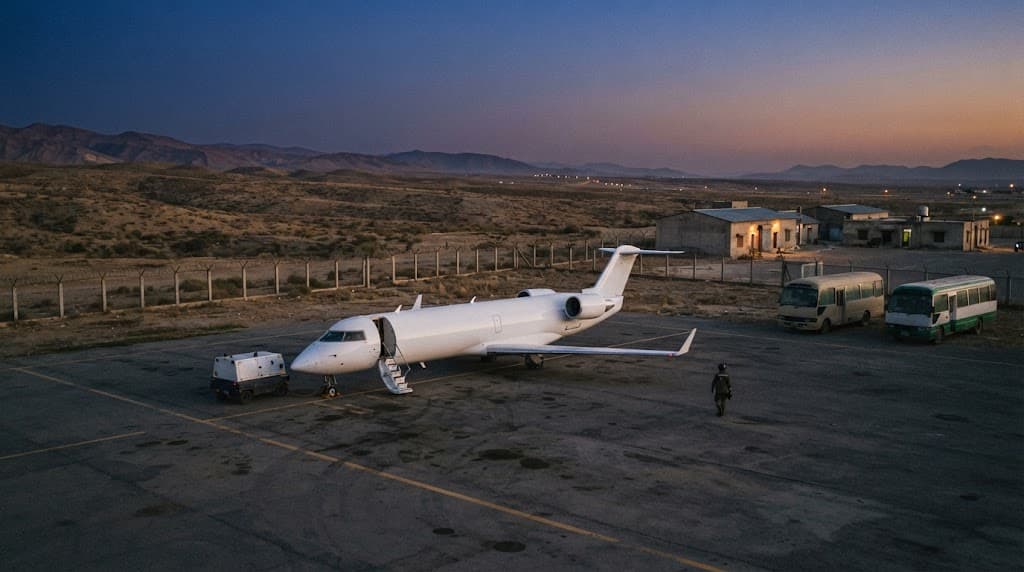
The United States is preparing to send nearly 200 Afghan nationals to Pakistan by air and then move them overland into Taliban-controlled Afghanistan, according to US court disclosures.
A sworn declaration filed on 30 October said a deportation charter originally scheduled for 3 November would land in Pakistan. From there, authorities would take at least one Afghan passenger across the border by land. Immigration and Customs Enforcement (ICE), the US agency that detains and removes people without legal status, outlined the route in that filing.
How the Pakistan transit plan emerged
Sergio Aguilar, a supervisory detention and deportation officer at ICE, said in the declaration that he first expected the charter to land in Afghanistan. He later learned Pakistan would be the flight’s final air stop, with onward travel to Afghanistan by road. He also said the removal order for the Afghan national at issue still named Afghanistan as the intended destination.
The filing sits inside Sadat v. Mullin, a federal case about Said Mansor Sadat, a 30-year-old Afghan national. Officials had placed him on a special charter leaving Alexandria, Louisiana. US District Judge Michael Nachmanoff ordered federal authorities to say whether the aircraft would fly straight to Afghanistan or stop in Pakistan.
Simon Sandoval-Moshenberg, who represents Sadat and another Afghan facing removal, said in an email that officials had told both clients they would fly to Pakistan and then travel overland to the Afghan border. Neither man was told who would move them or how the journey would work.
ICE later removed Sadat from the passenger list and released him, the lawyer said, after a judge ruled that holding him further violated his due process rights. The second client was still waiting for a ruling on an emergency temporary restraining order when the disclosures were reported.
Other court cases and open questions
Separate federal cases in Texas and Louisiana have added detail to the same Pakistan transit pathway. In a 15 October order, US District Judge Kathleen Cardone said ICE had acknowledged nominating Basir Ahmad Ahmadi for a possible early-November removal operation to Afghanistan. Ahmadi sought emergency protection, arguing Pakistani authorities could arrest him and hand him to the Taliban. Cardone denied that request on 29 October, finding the district court lacked jurisdiction to stop the removal.
In Louisiana, Afghan national Khaled Khaleeq also sought emergency relief after learning from news coverage and other detainees that officials might send him to Pakistan or Afghanistan. A federal judge denied his request on 30 October; later filings asked the court to reconsider.
Major questions remain. It is not clear whether Pakistan has agreed to accept the deportees, or which government would manage the land transfer into Afghanistan. The Department of Homeland Security (DHS), the US parent department for ICE, did not say whether Pakistan had given assurances for this operation, or whether any guarantees would cover the onward journey or treatment inside Afghanistan. A spokesperson said ICE’s responsibility ends once people leave its custody.
Timeline: what has happened so far
- 15 October: Judge Cardone records ICE’s nomination of Basir Ahmad Ahmadi for a possible early-November removal toward Afghanistan.
- 29 October: Cardone rejects Ahmadi’s emergency bid, citing lack of jurisdiction.
- 30 October: ICE officer Aguilar files a declaration on the Pakistan landing plan; a Louisiana judge denies Khaled Khaleeq’s emergency request.
- 3 November: The charter flight for Afghan deportees was originally scheduled to land in Pakistan.
- After court intervention: ICE removes Said Mansor Sadat from the passenger list and releases him following a due-process ruling.
Aasan alfaaz mein
America lagbhag 200 Afghan logon ko pehle Pakistan bhejne ka irada rakhta hai. Wahan se unhein sarak ke zariye Afghanistan le jaya jana hai. Abhi yeh saaf nahi ke Pakistan ne is plan se ittifaq kiya hai ya nahi. Adalat ke kaaghazat se yeh mamla samne aaya hai, lekin transfer ka poora tareeqa abhi ghayab hai.