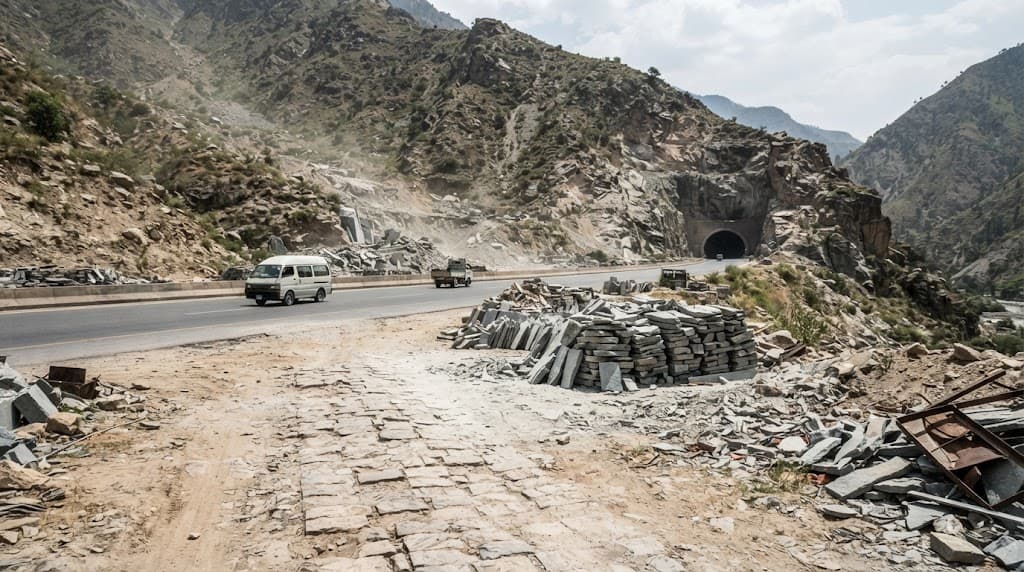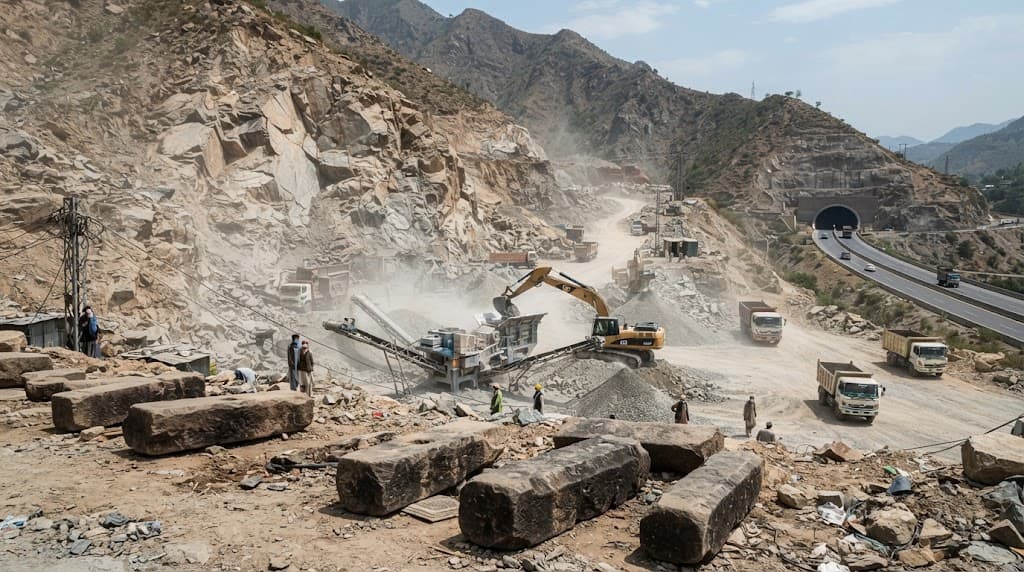
Activists and archaeologists have raised concern over mining, blasting and stone-crushing near the Swat Motorway tunnel. They say the work threatens an ancient road with heritage value, as well as the main gas pipeline serving Malakand Division. Malakand commissioner Iqbal Hussain said he had told the local deputy commissioner to act, and he promised quick action on the danger.
Heritage road and excavations
The road at risk is a branch of an old route network that crosses the Shahkot Pass. It is believed to be around 2,000 years old and traced back to the Buddhist period. Local people call the stone route the Elephant Road, or Hathi-lar, because of its width and solid construction. Local historian Akbar Khan regards it as a significant heritage site.
The pass also features in Yusufzai history. The Yusufzai Pashtuns, led by Malik Ahmad Khan, entered Swat through it in the early 16th century. In the mid-19th century, local defenders from Thana and Aladand held the pass during the Raniai wars, pushing the British back to Malakand and prompting them to build a longer, higher route over the mountains.
Research under the Khyber Path project, run by the Italian Archaeological Mission with Ca' Foscari University of Venice and the Khyber Pakhtunkhwa archaeology directorate, has found that the Alamkot-Hathidara monument is part of a larger fortified city that was not previously identified. Project director Luca Maria Olivieri said the stone-paved Hathi-lar road is a key segment of the Uttarapatha, the subcontinent's great northern highway. Researchers say it is the only surviving stretch of that highway in the region. Digs also uncovered the base of a large temple from the late Shahi period, and dozens of carved stone blocks, some weighing up to 250kg, were moved to the Swat Museum after recording. Excavations are expected to run into 2026 and 2027.
Risks to the tunnel and gas line
Activists argue that repeated heavy blasting in the rock is the most serious hazard, because the quarries lie just beside the motorway's longest tunnel. Nasir Khan warned that cracks could soon show up in the tunnels. Residents are also worried that shaking from the blasts may harm the SNGPL (Sui Northern Gas Pipelines Limited) line. The pipeline carries gas to every part of Malakand Division, so a break would leave the whole area without supply.
The warnings come as officials and international partners promote the area for heritage tourism. The Khyber Path project plans a 125km tourism trail along the motorway, running from Butkara and Barikot through Gumbat Balo Khale, Alamkot and Hathi-lar, and extending to Palai, Asota and Taxila. Planners expect the trail to create jobs and encourage responsible travel. When contacted, Iqbal Hussain said he had already acted to address the threat and promised immediate action on the dangerous mining and blasting. Activists and archaeologists are asking the government to halt mining and stone-crushing without delay to protect the site and the infrastructure beside it.
Timeline: what has happened so far
- Last August: the archaeology department alerted Malakand's deputy commissioner to mining and blasting near the tunnel.
- November 2025: findings from the Khyber Path project on the Alamkot-Hathidara monument were published.
- Activists and archaeologists raised the alarm, and the Malakand commissioner promised immediate action.
- 2026 and 2027: excavations at the site are expected to continue.
Aasan alfaaz mein
Swat Motorway tunnel ke qareeb pathar todne ke liye rozana dhamaakon ki wajah se tashweesh hai. Activists ka kehna hai ke is se tunnel mein daraarein aa sakti hain aur Malakand Division ko gas dene wali pipeline ko nuqsan ho sakta hai. Malakand ke commissioner ne fori action ka wada kiya hai. Aam logon ke liye matlab yeh hai ke gas ki supply aur sadak ki hifazat par nazar rakhni hogi.