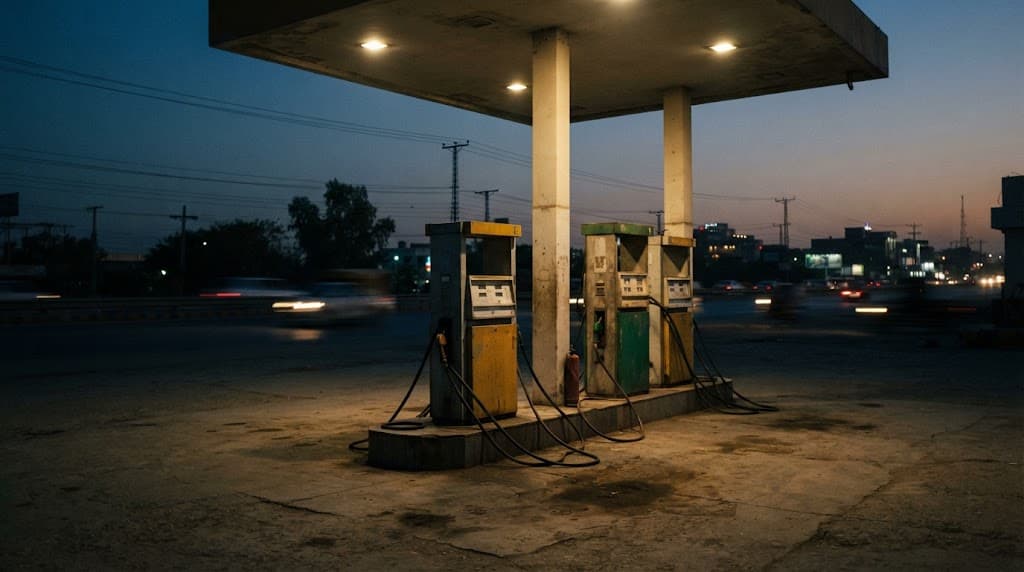
The petrol price in Pakistan today remains under a heavy tax burden after Planning Minister Ahsan Iqbal on Thursday ruled out any immediate cut in the petroleum levy under political pressure from Jamaat-e-Islami. He said the government would only consider a gradual reduction from the next budget, while stressing that relief must not put hard-won macroeconomic stability at risk.
Readers checking the petrol price in Pakistan today will still see pump rates shaped by these taxes: the government is charging Rs80 a litre as petroleum levy, Rs5 a litre as climate levy and Rs20.56 a litre as customs duty, taking total taxes to nearly Rs106 a litre.
Why the government is holding the levy
Iqbal told the media that Pakistan’s current macroeconomic situation, managed with great difficulty, “cannot afford a repetition of the mistakes of the past.” He argued that oil prices were rising worldwide and that countries were taking precautionary steps against possible economic shocks.
He warned against decisions made for short-term applause that could become a crisis later, saying no one knows how global conditions may unfold or where oil prices might move. Within limited resources, he added, the government was still trying to provide public relief, including a support scheme for low-income households that has already registered about 12.7 million people.
Petroleum Minister Ali Pervaiz informed the National Assembly that petroleum levy collection is part of the fiscal targets agreed under the International Monetary Fund (IMF) Extended Fund Facility—the IMF programme under which Pakistan must meet agreed budget goals. From fiscal year 2022-23 to 2025-26, the government collected Rs4.4 trillion under the levy against a target of Rs4.2 trillion—Rs227 billion more than planned. In the last fiscal year, provisional collection was Rs1.567 trillion against a target of Rs1.468 trillion. The budget estimate for the current fiscal year is Rs1.676 trillion.
Committee with Jamaat-e-Islami, not an immediate cut
Jamaat-e-Islami has been protesting the levy while global prices remain high amid Middle East conflict, and a JI delegation also met the prime minister this week. Iqbal said a committee has been formed so both sides can discuss “feasible proposals and measures” for a phased levy reduction in the next budget.
From the government side, Deputy Prime Minister Ishaq Dar, the planning minister and Rana Sanaullah will sit on the panel; Jamaat-e-Islami will nominate three representatives. Iqbal framed the talks as a shared interest in public relief, while still rejecting an immediate rate cut.
In May this year, Ali Pervaiz had written to the finance minister proposing an annual levy target of Rs1 trillion and a rate of Rs50 a litre because of high global prices. That lower rate was not adopted; the levy remains Rs80 a litre.
Fuel stocks and the next petrol price update
Any petrol price update still depends on international oil costs plus these domestic taxes. On supplies, Pervaiz told the Assembly that the Oil and Gas Regulatory Authority (OGRA)—the regulator that oversees oil and gas pricing and stocks—monitors the national oil chain with refineries, oil marketing companies and other agencies.
As of 22 September 2026, petrol stocks were about 395,000 tonnes, with further cargo at berth and outer anchorage bringing total availability to around 506,000 tonnes—roughly 22 days’ cover at average daily sales of 22,500 tonnes. High-speed diesel stocks were about 568,000 tonnes, or about 30 days’ cover. For September 2026, petrol imports of about 511,000 tonnes were planned; no diesel imports were planned because of healthy opening stocks and expected refinery output.
Timeline: what has happened so far
- May 2026: Petroleum Minister Ali Pervaiz wrote seeking a Rs50-a-litre levy rate and a Rs1 trillion annual target amid high global prices.
- Fiscal years 2022-23 to 2025-26: Levy collection reached Rs4.4 trillion, about Rs227 billion above the government’s Rs4.2 trillion target.
- 22 September 2026: Petrol availability stood near 506,000 tonnes (about 22 days’ cover); diesel near 568,000 tonnes (about 30 days).
- This week: A Jamaat-e-Islami delegation met the prime minister over the levy.
- Thursday: Ahsan Iqbal ruled out an immediate levy cut; Ali Pervaiz told the National Assembly the levy is tied to IMF fiscal targets and reported stock and collection figures.
Aasan alfaaz mein
Sarkar ne petrol levy mein fori kami nahi ki. Ab bhi petrol par lagbhag Rs106 tax hai, jisme Rs80 petroleum levy shamil hai. Jamaat-e-Islami ke pressure ke bawajood Ahsan Iqbal ne kaha ke agar kami hogi to agle budget se dheere dheere. Aam logon ke liye matlab yeh hai ke pump price abhi levy ki wajah se mehngi rehne wali hai.