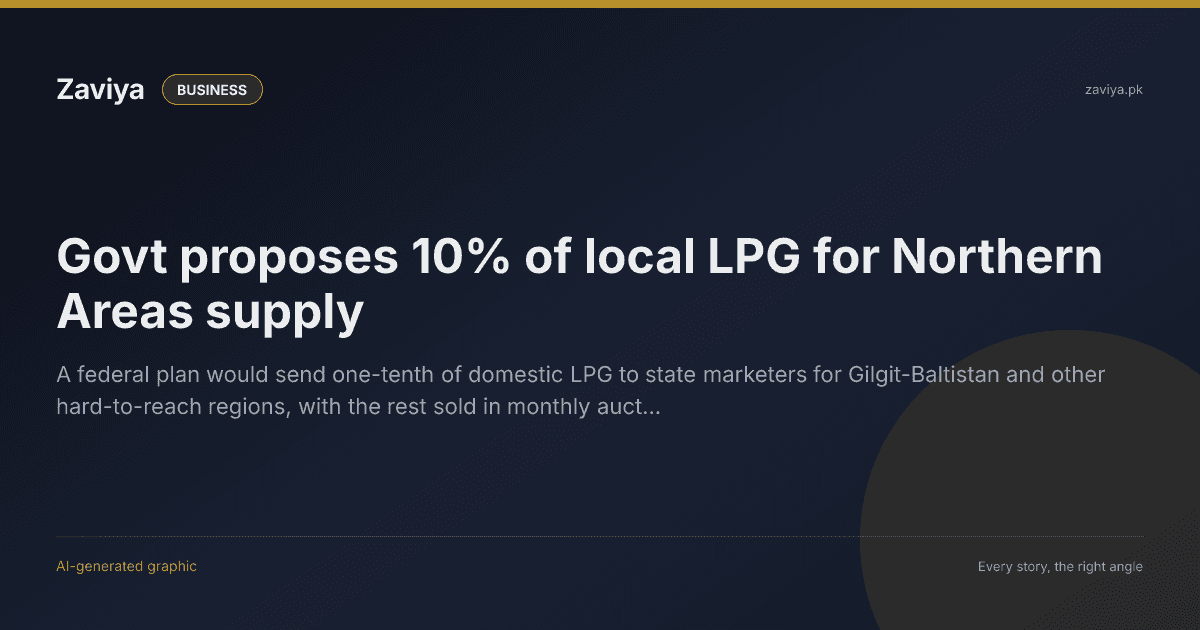
The federal government has proposed changes that would reshape how LPG price in Pakistan today is set for domestic supply, reserving 10% of locally produced liquefied petroleum gas for remote and hard-to-reach areas so cylinder and air-mix supplies do not dry up.
Under the plan, exploration and production firms, refineries and other domestic producers would hand that tenth of output to state-owned marketing companies at producer prices. Officials say the allocation is aimed mainly at the Northern Areas, Gilgit-Baltistan and other hilly regions where piped gas is scarce and households depend on cylinders.
How the 90% auction would work
The remaining 90% of local LPG would be sold through transparent monthly auctions open to bottlers prequalified by the Oil and Gas Regulatory Authority (OGRA), the sector regulator. The auction floor would sit 5% below Pakistan State Oil’s (PSO) import-parity price—the benchmark used to compare local offers with the cost of bringing LPG in from abroad.
Prequalification would weigh investment in storage and infrastructure, cylinder availability, geographical coverage and operational capacity. The framework also includes safeguards against cartelisation—coordinated pricing or supply deals among sellers. A special rule would let PARCO place 75% of its auctionable share with its subsidiary, PARCO Pearl Gas Limited (PPGL), and offer the other 25% in the monthly auctions.
Why remote supply is in focus
LPG availability in Pakistan is already uneven. The government summary notes that more than 10 million households are on the piped natural gas network, while over 25 million—especially in remote areas—rely on alternative fuels, including LPG. Domestic natural gas production is declining, and rules limit how far the piped network can expand, so more families are expected to turn to cylinders.
Pakistan’s LPG market is about 2.4 million metric tons a year and has grown at an average 7.5% annually over the past six years. Demand is projected to rise by 8% to 8.5% a year. A KPMG analysis cited in the government summary sees demand climbing from 2.4 million tons in FY2025-26 to 4.16 million tons by FY2032-33, while domestic production rises only from 0.96 million to 1.35 million tons. Imports would need to grow from 1.4 million to 2.8 million tons by 2033. The government estimates that about 71% of current LPG supplies already come from abroad.
What happens next
The proposal is a policy design, not yet a finished retail tariff notice. If adopted, LPG in Pakistan today would move on two tracks: a reserved stream at producer prices for state marketers serving remote regions, and an auction stream that could influence what bottlers pay for the bulk of local output. Households and shopkeepers will still watch the LPG price in Pakistan today for any later OGRA or marketing-company notifications that translate the framework into cylinder rates.
Aasan alfaaz mein
Sarkar chahti hai ke mulk mein banne wale LPG ka 10% hissa door daraaz aur pahari ilaqon ke liye mehfooz rahe. Yeh gas state companies ko producer price par milegi, khas tor par Northern Areas aur Gilgit-Baltistan ke liye. Baqi 90% har mahine auction mein bikega, jahan floor price PSO ki import price se 5% kam hogi. Jo log cylinder use karte hain, unhein supply zyada qaim rehne ki umeed hai, lekin asal cylinder rate baad mein alag se set hoga.