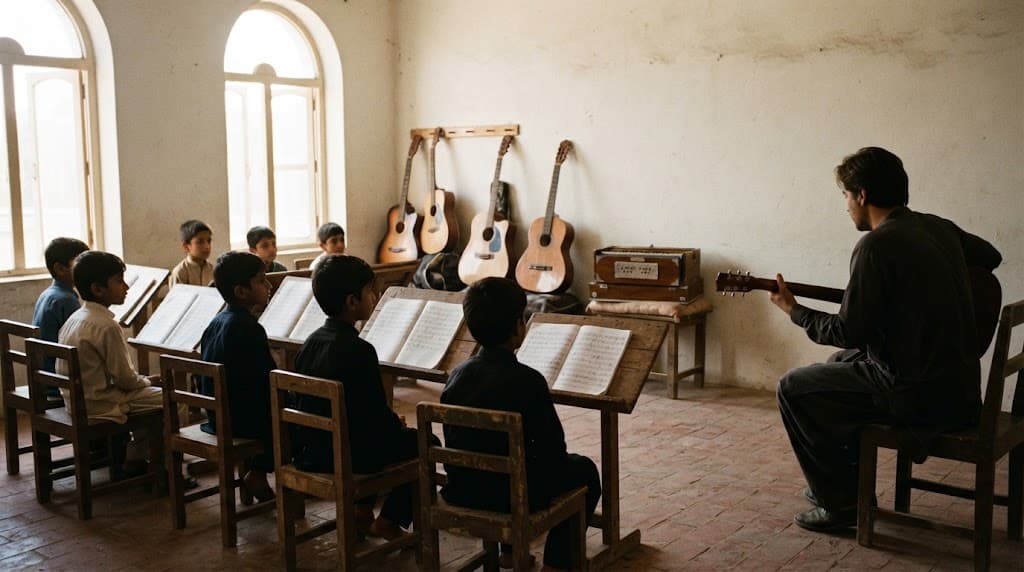
Norwegian performer William Gamborg joined children at Lahore’s Sur Taal Music Academy in singing Pakistani songs, and videos of the sessions quickly moved across social media. Clips featuring numbers such as Alfaaz and Ranjya Ve drew admiration from Indian listeners and briefly shifted online attention toward a shared cultural experience rather than political dispute.
The performances, reported with a November 1 dateline, underlined how a classroom encounter in Pakistan can travel far beyond its walls. Admiration from across the border has, in turn, opened a wider conversation about whether music can help sustain people-to-people ties between India and Pakistan when official relations are tense.
Music, borders, and a Lahore classroom
At Sur Taal, Gamborg sang alongside young pupils rather than on a formal concert stage. That informal setting is part of what made the clips travel: viewers saw a foreign artist learning and performing Pakistani repertoire with children, not a polished diplomatic showpiece.
Observers have framed the response as evidence that digital platforms can carry cultural affinity even when state narratives remain hard. The moment does not settle political disagreements, but it does show how quickly a musical exchange in Lahore can find an audience in India.
Kashmir’s poets and living collaboration
The attention around Gamborg has also revived discussion of Kashmir’s literary and Sufi inheritance as material for cross-border collaboration. That tradition stretches from mystic poets such as Lal Ded and Habba Khatoon to modern figures including Ghulam Ahmad Mahjoor, Abdul Ahad Azad, Dina Nath Nadim, Rahman Rahi, and Amin Kamil.
Lal Ded’s short Kashmiri verses, known as vaakhs, remain central in cultural memory; historian Dean Accardi has described how poems attributed to her have long been recited at Kashmiri cultural events and festivals. Habba Khatoon’s verses of love, longing, and separation stay alive in folk imagination, while later writers brought social themes, modernism, and criticism into Kashmiri letters. Rahman Rahi received the Jnanpith Award for Siyah Rood Jaeren Manz, becoming the first Kashmiri-language writer to win India’s highest literary honour.
A younger generation of Kashmiri artists is already bridging that heritage with contemporary sound. Singer-songwriter Yawar Abdal has drawn on Kashmiri, Persian, and Urdu poetry; Ali Saffudin has brought Habba Khatoon ballads such as Chol Hama Roshe and Rah Bakshtam to newer listeners; and Mohammad Muneem of the band Alif has explored Kashmiri-language work in modern arrangements. Commentators argue that joint projects—among Kashmiri, Pakistani, and Indian musicians—could carry these texts further without stripping them of language or context.
Soft power, Track II, and what comes next
Academic work has examined music as a channel for cultural diplomacy. Mayank Mishra, at Jawaharlal Nehru University’s Centre for South Asian Studies, has written on how artistic exchange can foster people-to-people links as an alternative to hostile bilateral narratives. Such research does not claim that songs change government policy; it only maps space for dialogue.
Track II diplomacy—unofficial contact among artists, academics, former diplomats, and civil society—has long been discussed as a parallel track to formal talks. Samir Ahmad, at the Central University of Kashmir, has called Track II “an important medium to explore new policy options between India and Pakistan,” including on difficult subjects. Music cannot resolve territorial disputes or erase the costs of conflict, but sustained exchange—collaborative recordings, workshops, translations, and performances rooted in Kashmiri selection and interpretation—could outlast a single viral clip and also support traditions such as Kashmir’s sufiana mausiqi.
The Sur Taal videos featuring William Gamborg have shown how quickly admiration can cross a border. The harder task, as the conversation now frames it, is to turn that flash of goodwill into lasting work for artists and audiences on both sides.
Aasan alfaaz mein
Lahore ke Sur Taal academy mein Norwegian singer William Gamborg ne bachon ke saath Pakistani gaane gaye. Inki videos social media par faili aur India mein logon ne taarif ki. Yeh dikhata hai ke mauseeqi siyasi tanav ke bawajood logon ko qareeb la sakti hai. Aam sunne walon ke liye yeh ek seedha paigham hai: hamare gaane aur bacchon ki mehnat sarhad paar bhi pasand ki ja sakti hai.