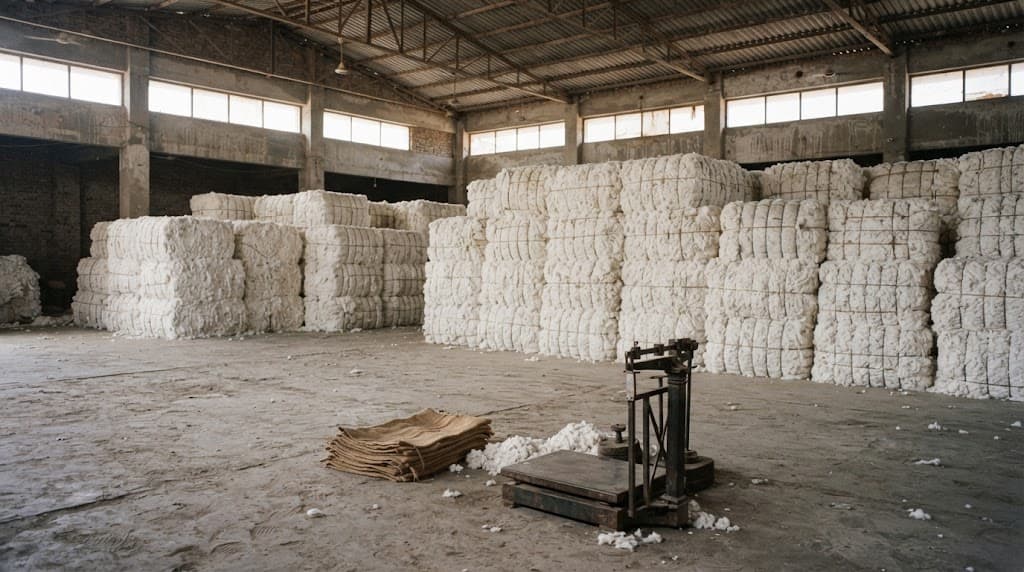
The cotton spot rate today in Pakistan has fallen by Rs300 per maund. The Spot Rate Committee of the Karachi Cotton Association closed the rate at Rs18,000 per maund after the cut, as fresh selling pressure hit the local market and New York prices also softened.
Across Sindh and Punjab, cotton is changing hands between roughly Rs16,500 and Rs18,500 per maund depending on quality and payment terms—about a Rs2,000 spread. Seed cotton, known as phutti, is fetching Rs7,000 to Rs9,200 per 40 kilograms. In Balochistan, lint is quoted between Rs17,600 and Rs18,200 per maund, with seed cotton at Rs7,200 to Rs9,400.
Higher arrivals, weaker quality
The Pakistan Cotton Ginners Association (PCGA)—the body representing cotton ginning factories—said arrivals reached 4.1 million bales by 15 October, about 7.5 per cent above the same period last year. Ginners expect this season’s total to exceed last year’s, aided by hot weather, but say crop quality is comparatively poor. Both the larger volume and weaker grades are cited as reasons cotton prices Pakistan have stayed soft over the past week.
Naseem Usman, chairman of the Karachi Cotton Brokers Forum, said international prices were mixed overall. New York cotton was trading between 80 and 86 US cents per pound.
Mills, looms and tax pressure
Pakistan’s textile mills remain under strain from high interest rates and rising energy costs, with several units running below capacity. In Faisalabad, industry sources say 40 to 50 per cent of power looms have shut; owners put job losses at around 100,000. Stakeholders also argue that yarn and fabric imports outside the Export Facilitation Scheme (EFS)—a customs facility meant for exporters—have undercut local producers.
Ginning faces a sharper flashpoint. PCGA Chairman Sohail Mehmood Harral told a Multan press conference that unannounced Federal Board of Revenue (FBR) raids and record seizures in Sindh hubs including Sanghar, Tando Adam and Shahdadpur had forced some factories to halt work. Officials said locks were broken and records taken without prior legal notice. Cotton Ginners Forum Chairman Ihsanul Haq said the tactics had shaken ginning and oil mills nationwide. Industrialists put closed ginning units at over 100 in 2025-26 alone, and cumulative closures at more than 500 ginning factories, nearly 700 oil mills, 175 textile mills and hundreds of power looms. They also cited sales tax of 18 to 22 per cent and high power tariffs. Harral praised dialogue by tax offices in Multan and Bahawalpur and urged notices instead of raids.
Separately, textile stakeholders have pressed the prime minister for early steps on the next phase of the European Union’s Generalised Scheme of Preferences Plus (GSP+)—preferential tariff access for compliant exporters—warning that delay risks exports and jobs. The Towel Manufacturers Association said it is suspending and blacklisting exporters accused of harming towel shipments abroad.
Timeline: what has happened so far
- 15 October: PCGA reports 4.1 million bales arrived, about 7.5% above the prior year.
- 22 October: The Pakistan Textile Council writes to the prime minister seeking action to keep GSP+ access beyond December 2028.
- Past week: Local cotton stays under pressure; Karachi’s Spot Rate Committee cuts the rate by Rs300 to Rs18,000 per maund.
- 2025-26 season: Industry figures say more than 100 ginning factories have stopped, taking cumulative closed units above 500 nationwide.
- Since 2011: The Cotton Cess—a statutory levy on cotton—has remained fixed at Rs50 per bale, while cotton expert Sajid Mahmood notes costs have risen sharply.
Aasan alfaaz mein
Pakistan mein kapas ka spot rate Rs300 kam ho kar Rs18,000 per maund par aa gaya hai. Sindh aur Punjab mein kapas roughly Rs16,500 se Rs18,500 tak bik rahi hai, phutti Rs7,000 se Rs9,200 per 40 kilo. Zyada paidawar aur kamzor quality ki wajah se qeemat dabao mein hai. Power loom aur ginning pe pehle se mushkil hai, is liye mazdooron aur karobar donon ke liye yeh hafte ki khabar ahem hai.