Pakistan has warned at the United Nations that military AI risks grow sharply when systems run without effective human judgment and control, raising the chance of miscalculation and fast conflict escalation.
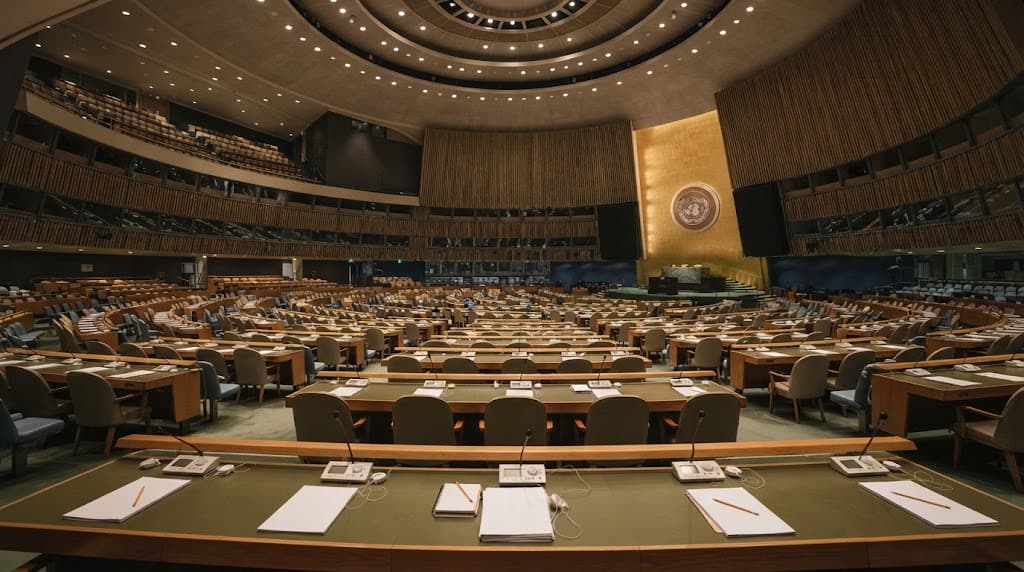
Speaking on 25 October at the General Assembly’s First Committee, Pakistani delegate Husham Ahmed said AI tools that lack that control also make it easier to resort to force and weaken respect for international humanitarian law (IHL) — the rules meant to limit harm in war. Ahmed, a counsellor at Pakistan’s Mission to UN offices in Geneva, was addressing a session on how the malicious use of information and communications technology (ICT) can threaten global peace and security.
What Pakistan told the First Committee
Ahmed argued that AI-enabled targeting and decision-support tools are no longer a distant prospect. He said they are already being fielded at scale in active conflicts around the world. In that setting, he pressed for inclusive, UN-led governance so the technology does not shrink the time available for military decisions to dangerous levels.
That concern, he said, is especially serious in regions where conventional and nuclear forces sit close together. “These dangers are acute in regions of close conventional-nuclear entanglement, where one nuclear-armed State has deployed autonomous loitering munitions and dual-capable missiles against another,” he said. Loitering munitions are weapons that can wait over an area before striking; dual-capable missiles can carry conventional or nuclear warheads.
Nuclear decisions and UN-led rules
Ahmed was clear on nuclear command. “The decision to employ nuclear weapons must always remain in human hands,” he said. He added that risks of artificial intelligence linked to conventional-nuclear entanglement need a full response, and that military AI governance must be rooted in the United Nations. Initiatives outside the UN, he argued, cannot match its legitimacy, inclusivity, and global reach.
ICT threats beyond the battlefield
Earlier in the discussion, Egriselda López of El Salvador — chair of the Global Mechanism on ICT developments and responsible state behaviour — called the mechanism’s creation a milestone after more than two decades of intergovernmental debate on ICT security at the UN. She said ICT-related threats keep evolving and hit states in every region, whatever their technology level. Their effects, she warned, go beyond digital systems: they can disrupt essential services, hinder economic development, and undermine international peace and security. Meeting those challenges, she said, needs every state’s attention in an open, inclusive forum.
Pakistan’s message sits inside that wider debate: keep people in the loop on high-stakes military AI, and keep rule-making at the UN so smaller and developing states are not shut out.
Aasan alfaaz mein
Pakistan ne UN mein kaha ke fauji AI bina insan ke faisle ke bohot khatarnak ho sakti hai. Is se ghalat andaza aur jang jaldi barh sakti hai. Nuclear hathiyar chalane ka faisla hamesha insan ke haath mein hona chahiye. Aam logon ke liye matlab yeh hai ke aman aur security ke qawaid UN ke zariye sab ke liye banain.