Pakistan olive oil production is expected to reach 716 tons this year, according to a government survey. The figure is a sharp climb from the 19 kg of olive oil recorded when national production began in 2016. Measured against imports and the wider edible oil market, the volume is still small, but for an industry that barely existed before, the growth is substantial.
Where the olives are grown
The survey counts 7.64 million olive plants across 60,456 acres in 131 districts. Balochistan has the largest share, with 3.20 million plants (41.9%) spread across 24,620 acres in 31 districts. Punjab has 2.24 million plants (29.3%), and Khyber Pakhtunkhwa has 1.66 million (21.7%).
Smaller numbers are recorded in Azad Jammu and Kashmir, Islamabad Capital Territory, Gilgit-Baltistan and Sindh. The survey estimates that Pakistan has about 4 million hectares with olive-growing potential. The government has focused planting on rain-fed (barani), marginal and degraded land rather than prime farmland, since olives suit those conditions better than crops that need good soil and plenty of water.
Processing and quality claims
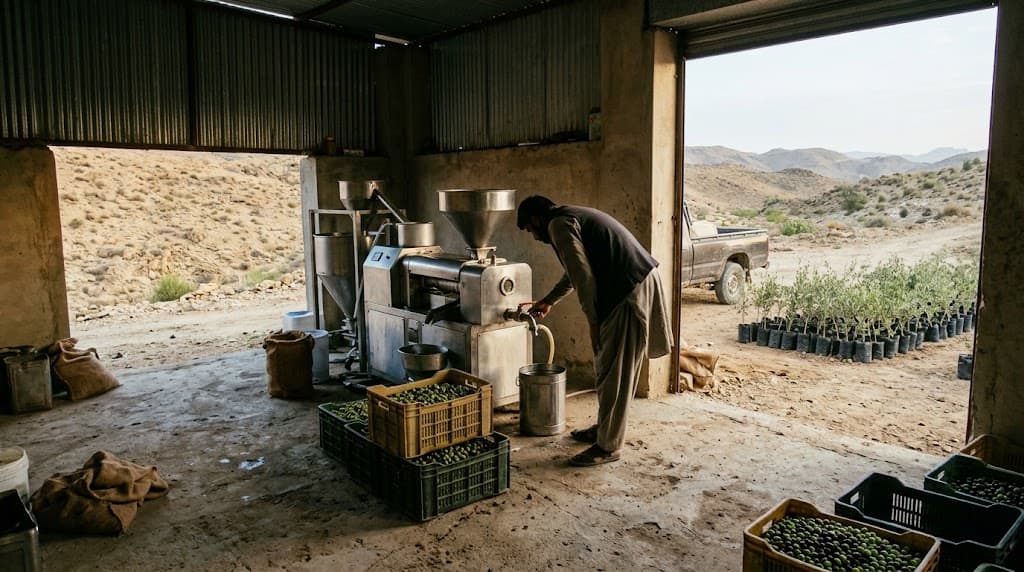
The survey records 51 olive oil extraction units, with 23 in Balochistan, 16 in Khyber Pakhtunkhwa, nine in Punjab, two in Islamabad and one in Azad Jammu and Kashmir. Three value-addition laboratories, six fruit-processing units, five weather stations, nursery tunnels and a national reference laboratory support the work.
Italian delegates who recently visited Pakistan were reported to consider Balochistan olive oil of international quality. Balochistan olives are also reported to yield about 18 kg of oil per 100 kg of fruit, compared with 12 to 14 kg in different parts of the world. These claims are not confirmed by official yield data in the survey, so they should be read as early indications.
Trade and imports
Exports have grown from 9 tons in 2020 to 249 tons in 2025, a 27-fold rise in volume in five years. Imports fell 33 percent in volume from their 2021 peak of 4,479 tons to 2,996 tons in 2025. Even so, 2025 imports were roughly four times the output now expected this year (2,996 divided by 716 is about 4.2).
Traditional foods still dominate demand. In consumer surveys, olive oil makes up 50 to 56 percent of regular consumption, table olives 32 to 39 percent, and olive-based care products 11 to 12 percent. Economies of scale and local distribution are cited as reasons Pakistani olive oil is not yet widely stocked on shelves.
The National Olive Value Chain Policy 2024-2030 targets 100,000 acres under olives and 10 million trees by 2030. The Pakistan Olive and Olive Oil Council, set up under the Pakistan Oilseed Board, brings farmers, processors and government together. The PakOlive certification trademark is reserved for oils that meet strict regulations and quality checks.
Aasan alfaaz mein
Pakistan mein zaitoon ke tel ki paidawar is saal 716 tonne tak pohanchne ki umeed hai, aik sarkari survey ke mutabiq. Zaitoon ke paudhe Balochistan mein sab se zyada hain, aur 2025 mein 249 tonne tel bahar bheja gaya. Aam log ke liye qeemat par fori asar abhi wazeh nahi hai, lekin local tel ki supply barhne se shelves par Pakistani zaitoon ka tel zyada dastiyab ho sakta hai.