A private consortium of US companies, backed by the Trump administration, is seeking investment of up to $4.4 billion in an integrated liquefied natural gas (LNG) venture in Pakistan. The plan covers imports, storage, re-gasification, transmission and sales to large buyers on a merchant basis—meaning capacity would be sold commercially rather than through a single government purchase deal.
The group brings together Global Vision Energy Partners (GVEP) and Khanjee Holdings, described as related firms, with strategic co-investors and General Mediterranean Holding, a Luxembourg-based US financial conglomerate. Sponsors say the Port Qasim Authority has consented to the proposed site and that an application for a provisional licence has been filed with the Oil and Gas Regulatory Authority (Ogra), which regulates oil and gas infrastructure. A special purpose vehicle has been set up to own and run the assets. Facilitation has also been conveyed through the Ministry of Maritime Affairs and the Petroleum Division of the Ministry of Energy, according to project documents.
How the $4.4bn plan is staged
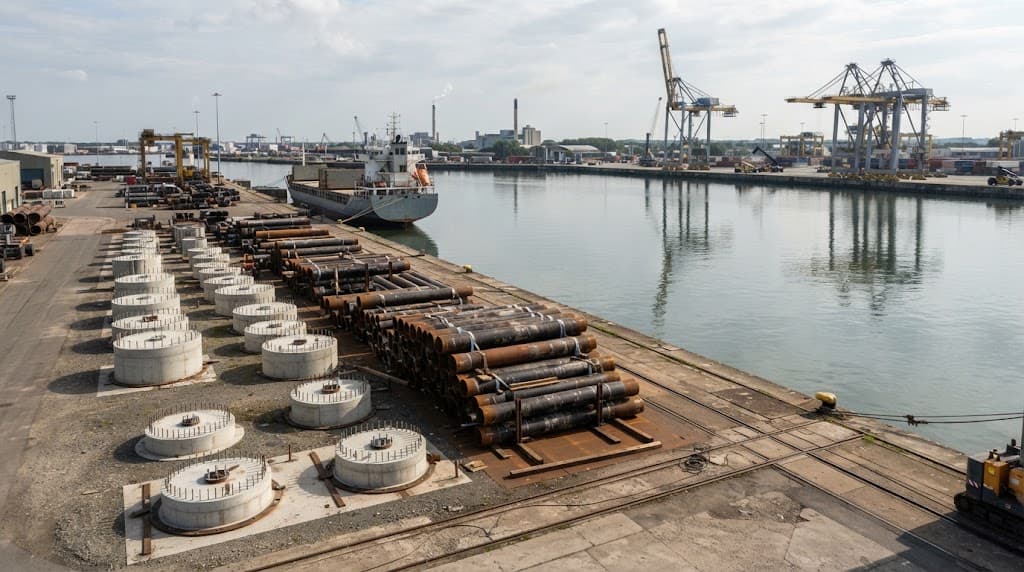
The US-backed LNG project is framed in two phases. The first would build an LNG terminal and storage complex with four tanks and an estimated annual throughput of about 35 billion cubic feet, at a cost of $1.7 billion. Each tank would hold 140,000 cubic metres, for a combined static storage capacity of 560,000 cubic metres. On three inventory cycles a year, sponsors project roughly 35.6 billion cubic feet handled annually, or about 11.9 billion cubic feet of storage per cycle.
The second phase would add a 1,100-kilometre pipeline of 42–48 inches diameter to move gas upcountry, with capacity of around 1.2 billion cubic feet a day. That step would take the total cost to $4.4 billion. Final costs would be fixed only after engineering, procurement and construction contracts are signed. Pakistan presently has no LNG storage tanks of its own, so domestic re-gasified LNG supply depends entirely on import logistics and international prices.
Financing, tariffs and ownership
The financing structure envisages a 70:30 debt-to-equity mix. In the first phase, GVEP would hold 26%, General Mediterranean Holding 24%, and Khanjee Holdings and strategic co-investors 20% each, with local investors taking the remaining 10%. The debt share of the $1.7 billion first phase is put at about $1.32 billion. Local equity stakes of up to 10% are being sought, with indicative tickets starting at $50 million per investor.
The project has been approved for consideration under the US Trade and Development Agency’s project preparation programme. Partial financing may come from the US Development Finance Corporation, with export-credit guarantees from the US Export-Import Bank for technology, equipment and services. Proposed first-decade tolling rates are $4.93 per million British thermal units (mmBtu)—a standard gas energy unit—for the terminal and storage, and $1.91 per mmBtu for transmission, falling later to $2.20 and $0.92 respectively. Domestic re-gasification tariffs would go to Ogra for approval; storage, tolling and transshipment for other users would be priced commercially.
Who else is involved—and what is still open
An earlier similar push by Energas, involving the Lucky Group and QatarEnergy, was dropped over energy-policy changes and unresolved fiscal questions. Islamabad had also previously pursued a North–South gas pipeline idea with Russia. Sponsors cast Port Qasim as useful for existing port infrastructure, carrier access and a location outside the Strait of Hormuz, a major energy shipping chokepoint. They hope to draw funds such as Grey Rock Investment Partners, Kohlberg Kravis Roberts & Co, Blackstone Inc., Saudi Arabia’s Public Investment Fund and the Kuwait Investment Authority—but say participation is still subject to due diligence and that no binding equity commitments are confirmed.
Aasan alfaaz mein
America se linked companies Pakistan mein bara LNG project laana chahti hain, jiska kharcha taqreeban 4.4 arab dollar ho sakta hai. Pehle Port Qasim par gas store karne ke tanks banenge, phir lambi pipeline se gas mulk ke anderoon le jaayi jaayegi. Abhi yeh sirf proposal hai—licence aur financing abhi puri nahi hui. Agar ban gaya to industry ko gas milne ka naya rasta mil sakta hai, lekin gharoon ke bill seedha is se link nahi kiye gaye.