The Sindh government has proposed a $7 million scheme to set up air quality monitoring stations in 23 districts, under the World Bank’s Country Partnership Framework (CPF) — the bank’s multi-year plan for work with Pakistan. Project documents describe a provincial network meant to produce reliable, real-time pollution readings and support firmer decisions on deteriorating air quality.
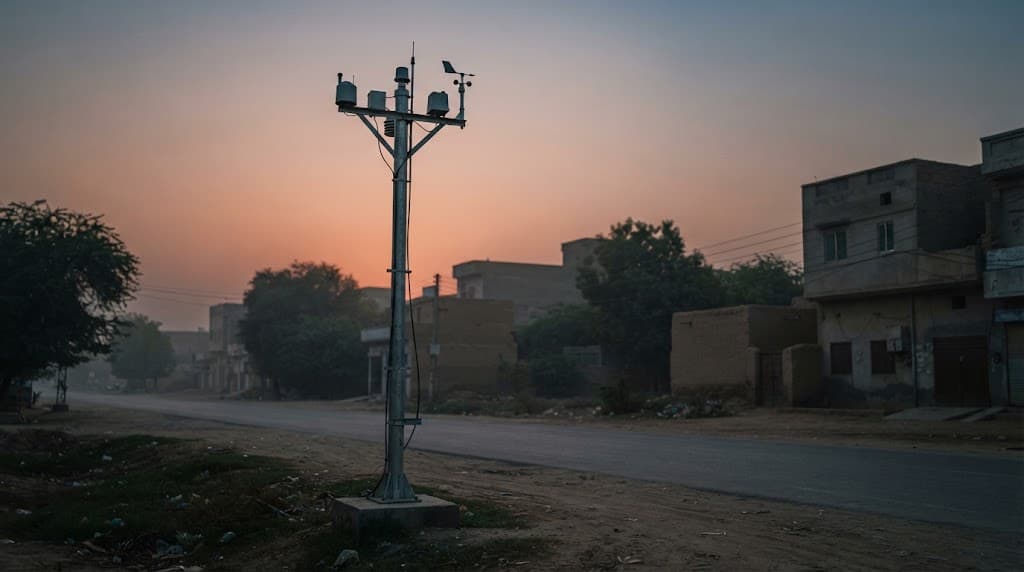
The initiative is formally titled “Air Quality Monitoring Network for Air Quality Management Improvement in Sindh – 23 Districts.” It envisages installing and running 23 continuous monitoring stations, linked into a real-time network with technical support systems.
Who would run the project
The Environment, Climate Change and Coastal Development Department (ECC&CDD) of Sindh would be the lead implementing agency. District administrations would act as partners. The estimated cost is $7 million.
Documents say the stations would measure major air pollutants: carbon monoxide (CO), nitrogen oxides (NO and NO2), sulphur dioxide (SO2), fine and coarse particulate matter (PM2.5 and PM10), suspended particulate matter (SPM), and ground-level ozone (O3). They would also record meteorological readings so officials can judge how weather affects pollution levels.
What already exists in Sindh
A Continuous Ambient Air Quality Monitoring System (CAAQMS) — ongoing outdoor pollution sensors that feed live data — has already been started in Karachi, Hyderabad and Sukkur. The remaining districts still lack that infrastructure. The proposed expansion is meant to close those gaps with a wider provincial network that can deliver consistent real-time data.
The plan also covers equipment calibration, data quality control, networking infrastructure and technical support so readings stay trustworthy. It includes long-term maintenance and institutional capacity building so the network does not stop after installation.
Why the data matters
A stated aim is to strengthen monitoring and tracking of Pakistan’s Nationally Determined Contributions (NDCs) — the country’s formal climate pledges on cutting emissions and limiting warming. Reliable pollution figures are expected to help emission-reduction planning, environmental policy and checks on progress against those commitments.
Documents also stress better public health risk assessments and early-warning capacity. Systematic pollutant tracking could help authorities spot trends, judge exposure risks and target interventions where air pollution is elevated.
Aasan alfaaz mein
Sindh sarkar 23 zilaon mein hawa ki quality check karne ke stations lagane ka $7 million ka plan bana rahi hai. Yeh stations smoke, dhool (PM2.5 jaise particles) aur doosre pollutants real time naapenge. Karachi, Hyderabad aur Sukkur mein pehle se kuch monitoring shuru hai; baqi ilaqon ko bhi cover karna maqsad hai. Behtar data se sarkar pollution aur sehat ke khatron ko pehle se samajh sakti hai.