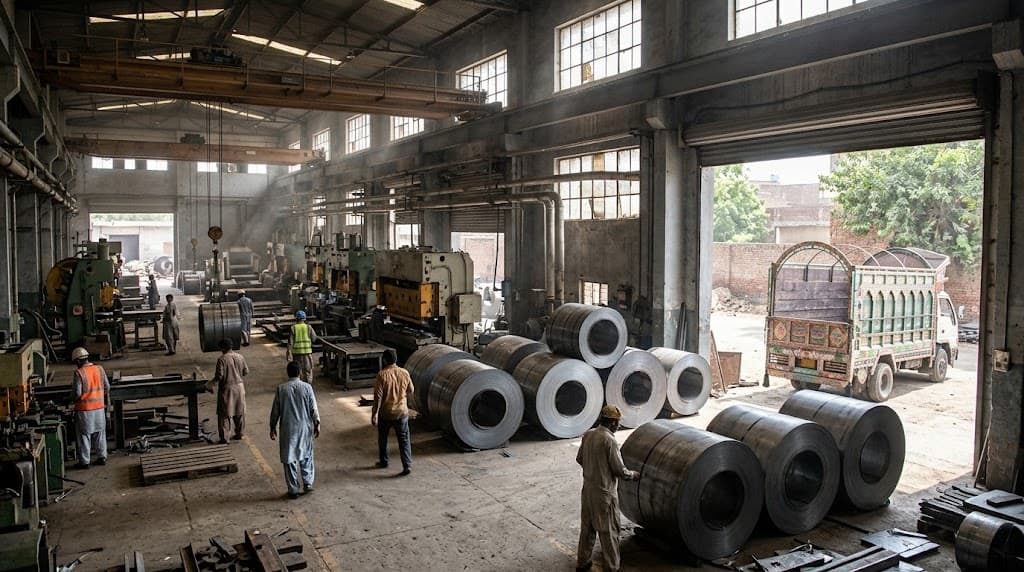
Pakistan's large-scale manufacturing output fell 4.96% month-on-month in August, according to provisional data from the Pakistan Bureau of Statistics (PBS), the federal agency that compiles the figures. Business leaders in Lahore said the drop showed that industrial activity remains fragile, and they called for immediate steps to restore confidence among investors and factory owners. Large-scale manufacturing, or LSM, measures output from bigger factories and is a key indicator of the health of the industrial sector.
What the data show
Compared with August last year, LSM output rose 0.67%, and cumulative growth for July and August of the current fiscal year, FY27, stood at 1.85%. The businessmen said the sharp monthly decline and falling production in key sectors raised doubts about whether Pakistan's large-scale manufacturing recovery could be sustained. Iron and steel production fell 11.56% year-on-year in August, while fertiliser output contracted 9% during the month.
The automobile sector was a bright spot, recording 11.66% year-on-year growth in August. The businessmen said this showed what industry could achieve when market activity improves. They cautioned, however, that higher taxes and uncertainty over automotive policies could weaken demand and discourage investment.
Costs, taxes and transport
The businessmen blamed high energy tariffs, expensive financing, rising input costs and an unpredictable tax regime for holding back manufacturers. They said industrial growth cannot last while production costs keep rising and firms struggle to stay competitive. They also pointed to disruptions in the movement of goods, which they said raise costs, delay deliveries and make it harder for factories to keep production schedules.
They noted that growth in information technology exports was encouraging, but argued that the country needs a broader revival in traditional manufacturing to create jobs on a larger scale. Weakness in steel and fertiliser could also affect construction, agriculture and their supply chains, they added.
What the businessmen want
The businessmen called for lower energy costs, a more competitive tax structure, affordable credit and consistent economic policies. They urged the government to review the tax burden on automobiles and other manufacturing sectors, and to set up a sustainable mechanism that prevents transport disruptions. They also asked policymakers to consult business representatives before introducing measures that affect industry and trade.
The businessmen said a coordinated strategy focused on reducing production costs, facilitating investment and ensuring policy continuity was essential to restore industrial momentum. They argued that a stronger manufacturing base would expand economic activity, create jobs, increase exports and reduce dependence on imported products.
Aasan alfaaz mein
Pakistan mein bade karkhanon ki paidawar August mein pichle mahine ke muqable mein 4.96 feesad kam hui. Karobari logon ka kehna hai ke energy ke mehngay rates, bhari tax aur saman ki transport mein rukawat factories ko mushkil mein daal rahi hai. Is se naukriyan aur investment dono khatre mein ho sakti hain. Business groups hukumat se laagat kam karne aur tax ka nizam aasan banane ka mutalba kar rahe hain.